Lightning protection for solar PV in Australia: what AS 1768:2021 asks of an array
AS 1768:2021 gives photovoltaic systems one short informative appendix. The clauses that decide an array's protection sit elsewhere: the risk method, bonding, surge protection and inspection.
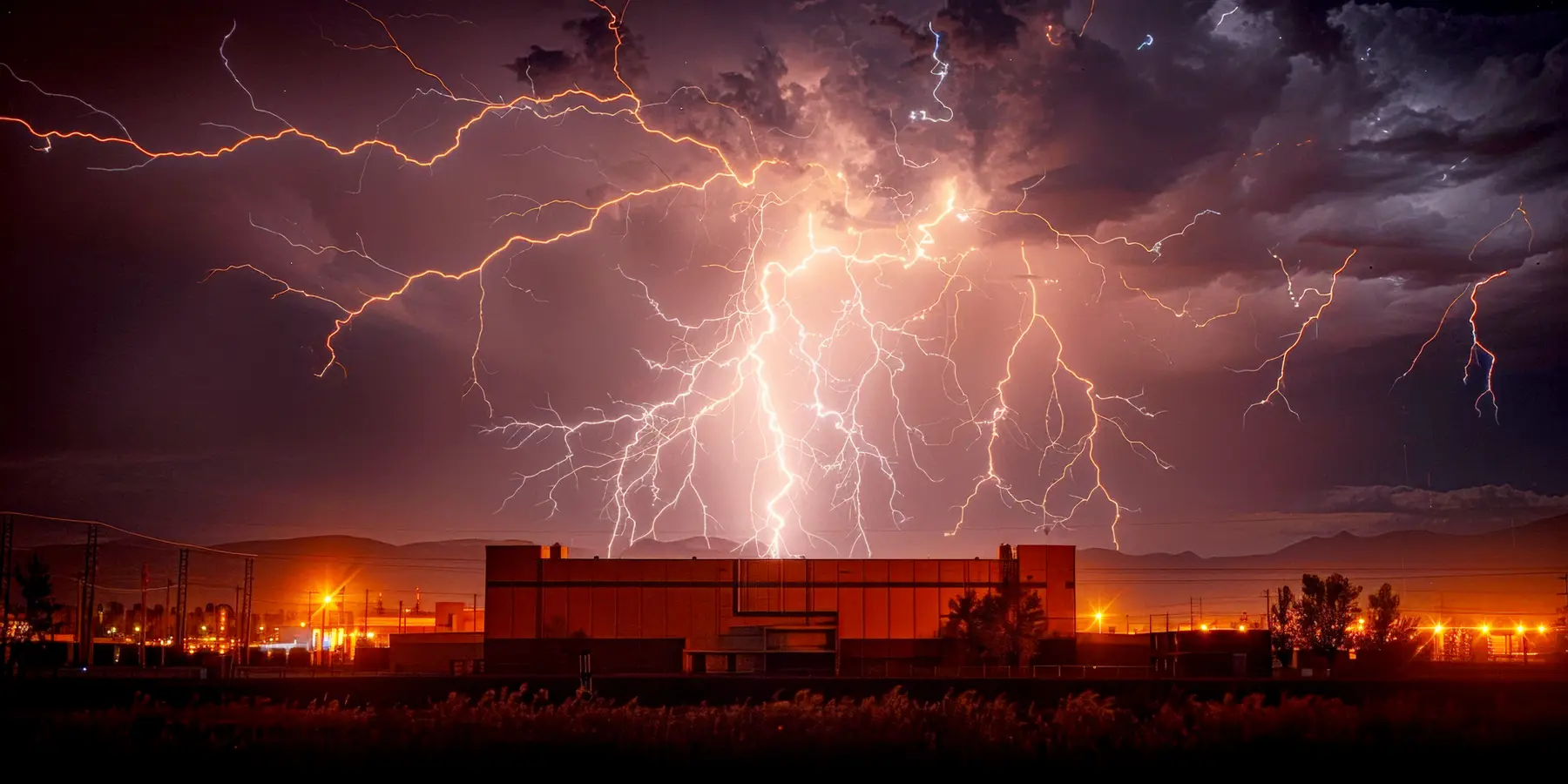
Lightning protection for solar PV in Australia rests on AS 1768:2021 for the risk assessment, the structure's protection and the surge devices, and on AS/NZS 5033 for the array installation. AS 1768:2021 gives PV only an informative Appendix N. The requirements that apply sit in its main body, Sections 2 to 5.
The quick answer for a rooftop array:
- Added panels to a roof? Clause 5.4.3 gives that as an example of an alteration after which the protection should be reassessed.
- The risk result decides. Direct strike protection is required where the assessment shows it is needed (3.1), and the same goes for surge protection (4.2.1).
- Bond or isolate. On a protected building, a metal array frame near the LPS must be either bonded to it or kept a separation distance away (3.6.1).
- An LPS brings SPDs. Whenever an LPS is fitted, incoming electrical services are bonded through SPDs (4.1).
This guide works through each rule as it applies to rooftop arrays, carports and solar farms, then covers wind turbines under Appendix K. Every clause cited is AS 1768:2021 unless named otherwise. Checked against AS 1768:2021 in September 2026. Buy the standard from Standards Australia for design work, and note that it does not apply in New Zealand.
What AS 1768:2021 Appendix N actually says
Appendix N is informative, so nothing in it is a requirement. It makes four points in four short sentences. A PV system is exposed and spread over a large area, so more damage from both direct and nearby strikes is possible. Lightning current can harm the installation. Avoiding failure takes lightning protection and surge protection designed to work together, it advises. And for the detail, you are referred to AS/NZS 5033.
Clause 1.1.2(f) lists Appendix N among the appendices that deal with specific occupancies, alongside Appendix K for wind turbines and Appendix M for mines. Clause 1.1.2 also says that to conform to AS 1768:2021, air terminals must be placed under Section 3. That applies to a structure carrying panels just as it applies to any other.
AS/NZS 5033 appears in the AS 1768:2021 Bibliography, not in its normative references in Clause 1.2. The Clause 1.2 note explains that documents listed only in the Bibliography are cited for information. So AS 1768:2021 does not make AS/NZS 5033 part of its own requirements. The two documents sit side by side, each governing its own scope.
Which Australian standard covers what on a PV project
A PV installation touches several documents. The lightning questions are answered in AS 1768:2021, the array questions in AS/NZS 5033, and the building wiring in AS/NZS 3000.
| Question | Where the answer lives | Status |
|---|---|---|
| Does the structure or site need lightning protection at all? | AS 1768:2021 Section 2 and Appendix B, with the calculation tool (2.5.3) | Risk method; the result drives the shall clauses below |
| How is a solar farm assessed as a whole? | AS 1768:2021 Clause 2.5.4.2, distributed facilities | Recommended method |
| Where do air terminals go over the roof and array? | AS 1768:2021 Clause 3.2 and Appendix D | Normative |
| Bond the array frame, or keep it isolated? | AS 1768:2021 Clause 3.6 | Normative |
| When are SPDs required, and with what ratings? | AS 1768:2021 Section 4 and Table 4.1 | Normative |
| How are SPDs connected? | AS 1768:2021 Appendix F | Normative |
| What does lightning mean for a PV system in general? | AS 1768:2021 Appendix N | Informative |
| How is the PV array installed, isolated and earthed? | AS/NZS 5033:2021, revised by Standards Australia in 2021 | Separate standard |
| How often is the protection inspected? | AS 1768:2021 Clause 5.4.4 | Recommended interval |
Standards Australia describes AS/NZS 5033:2021 as covering mounting, wiring, isolation devices, earthing, shock protection, testing and commissioning for PV arrays. Its announcement of the 2021 revision says the standard aligns with IEC 62548:2016. This guide does not describe the content of AS/NZS 5033 beyond that.
Do you need to reassess after adding solar panels to a roof?
Yes. Putting photovoltaic panels on a building is one of the four example alterations AS 1768:2021 Clause 5.4.3 gives for reassessing the protection system. The others are a change of use, new communication antennas, and changes to the electrical, telecommunications or computing systems inside. A rooftop array usually triggers two of them at once: new equipment on the roof and new wiring through the building.
The reassessment starts with the risk. Section 2 judges four types of loss, human life, service to the public, cultural heritage and economic value, each against its own tolerable value in Table 2.1. Clause 4.2.1 also requires surge protection wherever the facility is protected from direct strikes. So the answer for your building comes from the assessment, not from a rule of thumb about panels.
One caution from Clause 2.5.3. Even when the spreadsheet reports that no direct strike protection is needed, Sections 3 and 5 still govern continuity and earthing, and the air terminations it assumes must be confirmed. A new array changes what sits on the most exposed parts of the roof.
How a rooftop array fits the building's LPS
On a building that already has, or now needs, a lightning protection system, the array has to sit inside it. Three parts of Section 3 decide how.
Keep the array in the protected zone
Air terminals are placed by the rolling sphere method. Any part of the structure the sphere touches is exposed and needs an air terminal (D.3.1). The radius follows the protection level, from 20 m at LPL I to 60 m at LPL IV (Table D.1). A tilted array raises new edges on a roof, so re-roll the sphere over the roof as it now stands.
Bond it to the LPS
Prominent metal plant on a roof must be bonded to the LPS (3.6.2(a)). Whether a metal array frame counts is the designer's call, and if it does, it must be bonded. A bonded frame may take part of the lightning current, so the frame and its bond must both be able to carry that share. Conductor sizes come from Table 3.3 via Clause 3.7.2. Long bonding conductors can still leave large potential differences.
Or keep it isolated
Isolation means enough air or insulation between the LPS and the array that no breakdown occurs. Equation 3.6.3 lets you calculate the separation distance S from the conductor length l to the nearest bonding point or the earth termination, scaled by factors for the protection level, the number of downconductors and the insulating material (Table 3.2).
Clause 3.6.1 makes one of the two mandatory: to prevent side flashing, you either bond or isolate. What you cannot do is leave a metal array frame a short distance from an air terminal or downconductor with neither. For the geometry of the sphere and the flat roof procedure in Clause D.3.2, see air terminal placement under AS 1768. The rolling sphere calculator can help you picture the zone, but it uses IEC 62305 geometry, so check the AS 1768:2021 radius before relying on it.
Solar farms: assessed as a distributed facility
A ground mounted solar farm is not one building, and AS 1768:2021 does not pretend it is. Clause 2.5.4.2 defines a distributed facility as standalone structures joined by electrically conductive services inside a site boundary, and it names ground mounted photovoltaic arrays as an example, next to water treatment plants, petrochemical plants and mine sites. Clause 2.5.4.1 says the spreadsheet only applies to standalone structures.
For a distributed facility, the clause recommends three steps. Take the area inside the facility boundary. Multiply it by the ground flash density Ng to estimate how many flashes the site receives each year. Then use that figure to choose protective measures by the hierarchy of controls in Clause 2.3, which ranks elimination first, then substitution, isolation and engineering controls, then administrative controls, then personal protective equipment. If the count suggests the site will be struck during its projected life, protection measures should be considered.
Clause 2.5.4.2 accepts that direct strike protection across a large open facility is not practicable, while standalone metal structures within it, such as tanks and pipework, are normally self protecting. To keep the plant running, it recommends protecting the equipment and the cables that link the structures under Section 4. Each standalone structure on the site, such as an inverter station, a control room or a substation building, then gets its own spreadsheet run. The clause adds that services leaving the site, such as a grid connection line, may need further calculation.
For utility scale sites, also read the lightning risk assessment for renewable energy, which covers solar farms, wind and substations across standards.
Where do SPDs go on a solar PV installation?
Section 4 sets where SPDs go on the a.c. side, and the risk assessment decides how far inside the building they must go. Appendix N advises designing them together with the lightning protection, because an array is exposed to direct and nearby strikes.
| Location | When AS 1768:2021 calls for it | Clause |
|---|---|---|
| Main switchboard, at the LPZ0 to LPZ1 boundary | Primary SPDs, whenever surge protection is required | 4.6.3(b) |
| Any distribution board whose cabling leaves the structure, such as a feed to a detached array, carport or inverter station | Where that cabling is exposed to direct or induced lightning effects | 4.6.3(d) |
| Distribution board or the equipment itself, such as the inverter | Secondary SPDs, where the risk assessment or the factors in 4.2.1 call for them | 4.6.4(b), 4.5 |
| Monitoring and data lines | Where the line first terminates, or as near the equipment as you can get | 4.7(b) |
| Metallic services entering the building | Bonded to the earth termination where they come in | 3.6.2(c), 4.1 |
| SPD earth on a building with an LPS | Bonded to the LPS earth termination network | 4.6.3(e) |
When surge protection is required, and how big
Surge protection shall be fitted where the risk assessment calls for it and wherever the facility is protected from direct strikes. It should be fitted where Ng exceeds 2 flashes per km² per year with overhead services (4.2.1), or where surge damage could affect safety or a public utility, or its economic consequences would be intolerable. For a service entrance on a building with an LPS, the Iimp is 10 kA (10/350) per phase (Table 4.1).
Keep SPD leads short
Informative Appendix G explains that the inductance of an SPD's connecting leads adds to its protection level. It gives a rough figure of 0.1 kV per kA per metre, so 10 kA through 1 m of lead adds about 1 kV (Equation G.4(1)). Its note in G.5.1 recommends point of entry SPDs to be bonded to the main earth bar with conductors of 1.5 m or less.
Protect the SPD itself
Temporary overvoltages on the supply can destroy an SPD, so each one needs an upstream overcurrent device able to isolate it, within the maker's maximum backup fuse rating and discriminating with the supply fuse. SPDs should sit upstream of any RCD.
The d.c. side is not in Table 4.1
Table 4.1 rates SPDs for a.c. power systems, Clause 4.6 applies to the MEN system, and Appendix F covers installing SPDs on low voltage power systems and on signal and data lines. AS 1768:2021 gives no ratings for SPDs on d.c. array wiring. Appendix N points you to AS/NZS 5033 for PV detail, so check it and the inverter maker's instructions for the d.c. side.
For how lightning protection zones, primary and secondary SPDs and Appendices F to H fit together, read surge protection under AS 1768:2021. For earthing the array and the building together, see earthing under AS 1768.
How the risk assessment sets lightning protection for solar PV
On a standalone building, the AS 1768:2021 method answers two questions at once: whether a lightning protection system is needed, and whether surge protection is. Appendix B splits each risk into components for flashes to the structure, flashes near it, flashes to a connected service and flashes near a service. Section 4 names the same four sources S1 to S4 in Figure 4.1. The indirect components, from flashes to or near the connected services and near the building, are the ones surge protection reduces (B.4.3), and long cable runs to an array give them more to work on.
The worked example in Clause C.3.4.2 shows the order for finding the least protection. After fire protection, it fits an LPS starting at LPL IV and working up, then adds SPDs at the point of entry, then SPDs on the equipment. Because Clause 4.1 bonds incoming electrical services through SPDs whenever an LPS is fitted, a rooftop array on a building that ends up with an LPS will always come with at least point of entry surge protection.
For a solar farm, the spreadsheet runs structure by structure as Clause 2.5.4.2 describes, and the facility level flash count is a separate, simpler calculation.
Wind turbines under AS 1768:2021
Appendix K is informative, like Appendix N. It explains why turbines are hard to protect: exposed sites, composite blades that cannot carry lightning current, and rotation that breaks the path to earth (K.1). Blade protection comes from the blade manufacturer (K.2.3), most often as an internal downconductor fed by receptors at the tip (K.2.2).
Appendix K advises protecting the rest of the turbine under Section 3, treating the blades as stationary and placed in the worst case position when you work out the protected zones (K.2.3). It also advises giving every turbine its own earth termination system, and measuring each turbine's earth resistance before connecting it to any other turbine (K.3). For wind and solar on one site, see the renewable energy guide.
Common mistakes, and what an inspector checks
Each of these is a gap an inspector can tie to a clause of AS 1768:2021.
No reassessment after the install
The panels go on and the old risk assessment stays on file. Clause 5.4.4 recommends an inspection after any alteration to the structure, and Clause 5.4.3 names PV panels as an alteration that should prompt a reassessment.
Array frames neither bonded nor isolated
A frame near a downconductor with no bond and no worked separation distance invites a side flash. Clause 3.6.1 requires one of the two, and Clause 3.6.2 requires the bond to carry its share of lightning current.
SPDs with long leads, or none at the right boundary
An SPD on a long tail loses much of its value (Appendix G). A board feeding an exposed array or carport is itself an SPD location under Clause 4.6.3(d), not only the main switchboard.
No records after the install
Keep the updated risk assessment with the records Clause 5.3 recommends: test results including earth resistance and continuity (5.3(d)), alterations, additions or repairs to the LPS (5.3(f)), and SPD condition indicator readings (5.3(g)). Clause 5.4.2(e) recommends inspecting SPDs and assessing their upstream overcurrent devices.
One spreadsheet run for a whole solar farm
Clause 2.5.4.2 says the spreadsheet does not apply to a distributed facility as a whole. Use the area and Ng count for the site, then run each standalone structure separately.
Treating Table 4.1 as a d.c. rating
Table 4.1 rates a.c. power SPDs only. See the d.c. side card in the SPD section above before you specify array SPDs.
Running the AS 1768 assessment for a PV project
Lumex runs the AS 1768:2021 risk method on Voltrace: R1 to R4, each against its own tolerable value, then the least protection by the C.3.4.2 search. For a building that has just taken a rooftop array, you enter the structure as it now stands and see whether an LPS is needed, at what level, and whether SPDs are needed at the point of entry, on the equipment or both. Every figure shows the working behind it, and the signed report records it.
The AS 1768:2021 method is a method for standalone structures (2.5.4.1). On a solar farm you run each inverter station, control room or building on its own, as Clause 2.5.4.2 describes. Lumex does not design the protection system: it does not place air terminals, size bonds, work separation distances or select d.c. SPDs, and it does not certify an installation. Periodic inspection reports are coming soon. Today it sets a review date 24 months out for AS 1768 assessments, in line with Clause 5.4.4, and reminds you when it falls due.
Enter the building as it now stands, with the array, and read the R1 to R4 result before you specify any SPD.
Related reading:
Solar PV lightning protection in Australia: common questions
How do I protect a solar inverter from lightning under AS 1768?
Does AS 1768 cover solar PV?
Which Australian standard covers PV lightning protection?
Do rooftop solar panels need lightning protection?
Should a rooftop solar array be bonded to the lightning protection system?
How is a solar farm assessed under AS 1768?
What does AS 1768 say about wind turbines?
How often should PV lightning protection be inspected in Australia?
Lumex computes the method of the standard you choose, IEC 62305-2:2024, AS 1768:2021 or NFPA 780-2026, and shows the working. It does not certify a structure. You may not issue or submit a Lumex output until a competent person, qualified where the structure is located, has reviewed the inputs and the result and signed it.
AS 1768:2021 Table 2.1 sets a tolerable value for each type of loss, and the owner chooses the one for economic loss. Every AS 1768 assessment in Lumex states the values that applied.
Get started today