Lightning protection standards Australia: the map around AS 1768:2021
AS 1768:2021 is the Australian lightning protection standard, but it never works alone. This guide maps every standard it calls on, from the Wiring Rules to hazardous areas and solar arrays, and shows which one governs each part of your project.
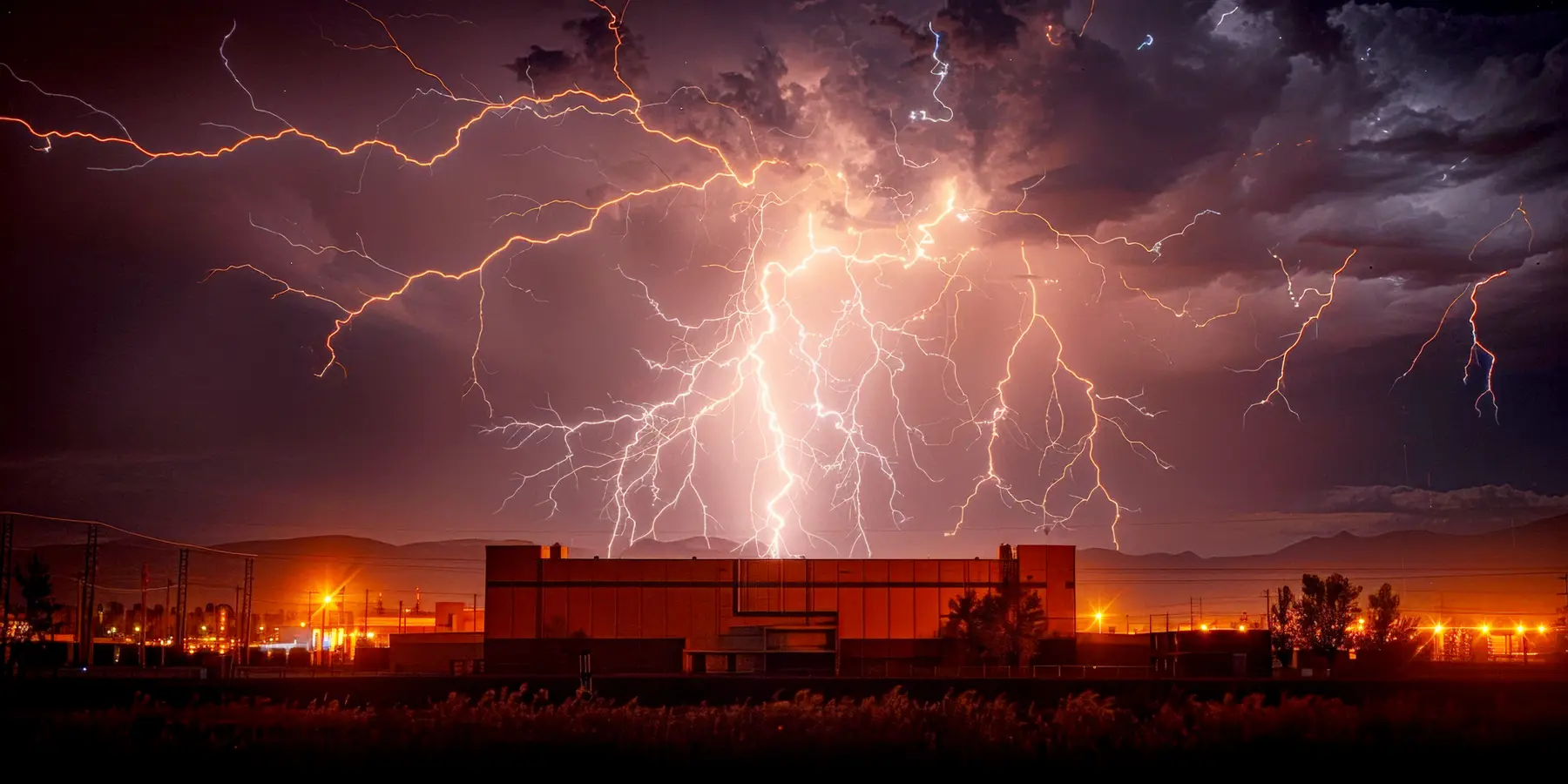
AS 1768:2021, published by Standards Australia on 3 December 2021, is the Australian standard for lightning protection. Beyond it, the lightning protection standards Australia relies on are the wiring, cable, earthing, hazardous area and solar rules that the lightning work connects to.
AS 1768:2021 names three standards as part of its requirements, points to more than twenty others in its notes and appendices, and borrows its risk method from IEC 62305-2. An engineer who reads only AS 1768 misses the wiring rules its surge protection clauses assume. An engineer who reads only the wiring rules misses the lightning earth.
This guide also covers where IEC 62305 fits, where the legal obligation comes from, and why New Zealand is on a different edition. Every clause cited is AS 1768:2021 unless the text says otherwise. For what the standard itself says, section by section, read AS 1768:2021 explained. Reviewed September 2026.
The three standards that are part of AS 1768:2021's requirements
Clause 1.2 lists only three normative references. Where AS 1768:2021 cites them, some or all of their content becomes a requirement of the lightning standard. The documents it cites for information are listed in its Bibliography, and a few more, such as the AS 2832 series, appear only in notes.
| Standard | Title, as AS 1768:2021 lists it | What it does for lightning work | Where AS 1768:2021 uses it |
|---|---|---|---|
| AS/NZS 3000 | Electrical installations (known as the Australian/New Zealand Wiring Rules) | Defines the MEN system, the main switchboard, the distribution board and the supply earth electrode that the surge protection and bonding rules build on | 1.2, 1.3.17, 1.3.36, 4.6.1, 4.6.3(b), 4.6.4(b), E.3.9.2, M.5.4 |
| AS/NZS 3008.1.1 | Electrical installations, Selection of cables, Part 1.1: Cables for alternating voltages up to and including 0.6/1 kV, Typical Australian installation conditions | Sizes the wiring that connects an SPD to the switchboard and its overcurrent device | 1.2, F.2, F.4, F.5 |
| AS/NZS 4065 | Concrete utility services poles | Governs concrete poles that carry the aerial conductor of a suspended air terminal network over a hazardous structure | 1.2, J.2.4 |
Titles appear as Clause 1.2 and the Bibliography of AS 1768:2021 print them, with the dashes between title parts shown as commas. Buy the full documents from Standards Australia; Lumex is independent of Standards Australia and does not reproduce any standard.
Which Australian standards does AS 1768:2021 point to?
Most of the lightning protection standards Australia uses sit here, in notes, appendices and the Bibliography. They are informative from the lightning standard's side, but each one governs its own field, so on a real job several of them bind you directly.
| Standard | Title, as AS 1768:2021 lists it | Why a lightning engineer meets it | Cited in AS 1768:2021 |
|---|---|---|---|
| AS/NZS 5033 | Installation and safety requirements for photovoltaic (PV) arrays | Solar arrays: Appendix N sends you here for coordinated lightning and surge protection of PV | Appendix N |
| AS/NZS 60079.10.1 | Explosive atmospheres, Part 10.1: Classification of areas, Explosive gas atmospheres | Classifies the gas and vapour zones that decide how much lightning protection a hazardous structure needs | 1.3.18, J.1, J.3 |
| AS/NZS 60079.10.2 | Explosive atmospheres, Part 10.2: Classification of areas, Explosive dust atmospheres | Classifies the combustible dust zones in the same way | 1.3.18, J.1, J.3.2 |
| AS/NZS 60079.14 | Explosive atmospheres, Part 14: Design selection, erection and initial inspection | Equipotential bonding in hazardous areas, and SPDs rated for the hazardous area | J.2.2, J.3.1, J.4 |
| AS/NZS 60079.17 | Explosive atmospheres, Part 17: Electrical installations inspection and maintenance | Inspecting and testing installations inside hazardous areas | J.4 |
| AS/CA S009 | Installation requirements for customer cabling (Wiring rules) | SPDs on telecommunications customer cabling | G.5.2 |
| AS 4262.1 | Telecommunication overvoltages, Part 1: Protection of persons | Assessing surge risk to people on a telecommunications service on its own, and bonding conductor length | B.1, E.3.9.1 |
| AS 4262.2 | Telecommunication overvoltages, Part 2: Protection of equipment | Assessing surge risk to equipment on a telecommunications service on its own | B.1 |
| AS/NZS 61008.1 | Residual current operated circuitbreakers without integral overcurrent protection for household and similar uses (RCCBs), Part 1: General rules | S-type RCCBs meet the breaking capacity asked of an RCD that has an SPD on its load side | F.3 |
| AS/NZS 61009.1 | Residual current operated circuitbreakers with integral overcurrent protection for household and similar uses (RCBOs), Part 1: General rules | S-type RCBOs meet the same breaking capacity | F.3 |
| AS/NZS 61439.1 | Low-voltage switchgear and controlgear assemblies, Part 1: General rules | The TN, TT and IT earthing codes, and typical impulse withstand values | 1.3.9.5, F.1.1 |
| AS/NZS 60950.1 | Information technology equipment, Safety, Part 1: General requirements | The equipment insulation level that bonding potentials are kept below | E.3.9.1 |
| AS 2067 | Substations and high voltage installations exceeding 1 kV a.c | Fall of potential earth testing, substation clearances, control system interference and earthing on mine sites | E.5.5, L.4.3, L.5, M.5.4 |
| AS/NZS 7000 | Overhead line design | Lightning impulse clearances on overhead lines | L.7.2, L.7.4 |
| AS 1307.2 | Surge arresters, Part 2: Metal-oxide surge arresters without gaps for a.c. systems | Surge arresters on high voltage cable circuits | L.4.4 |
| AS/NZS 3675 | Conductors, Covered overhead, For working voltages 6.35/11 (12) kV up to and including 19/33 (36) kV | Covered conductor thick (CCT) lines in treed areas | L.7.6 |
| AS/NZS 3007 | Electrical equipment in mines and quarries, Surface installations and associated processing plant | Earthing at mine sites | M.5.4 |
| AS/NZS 3004.1 | Electrical installations, Marinas and boats, Part 1: Marinas | The shore wiring a boat's LPS meets | I.6.3.4 |
| AS/NZS 3004.2 | Electrical installations, Marinas and boats, Part 2: Boat installations | The boat wiring a boat's LPS meets | I.6.3.4 |
| AS/NZS 4853 | Electrical hazards on metallic pipelines | Protecting pipelines and managing transferred potentials | E.3.8, I.9 |
| AS/NZS 3835.1 | Earth potential rise, Protection of telecommunications network users, personnel and plant, Part 1: Code of practice | Hazards from power system earth potential rise | E.3.8 |
| AS 2832 series | No title printed: a note to Clause 3.6.2 refers to the series | Cathodic protection, and the effect bonding has on metal that is cathodically protected | 3.6.2 |
| AS 2239 | Galvanic (sacrificial) anodes for cathodic protection | Backfilling galvanic anodes | E.3.7.3 |
| AS/NZS 2053 (all parts) | Conduits and fittings for electrical installations | Heavy duty conduit over downconductors on public shelters | I.8.1 |
| AS ISO 31000 | Risk management, Principles and guidelines | The general risk management frame behind the hierarchy of controls | 2.3 |
The IEC and other documents it relies on
AS 1768:2021 says in its Preface that it seeks to align with IEC standards, and it leans on them in three ways. The risk method comes from IEC 62305-2: Clause 2.2 says the spreadsheet calculations are taken from it and adjusted for Australian conditions, Clause 2.5.3 says the Appendix B approach has been simplified from it, and the tolerable risks in Table 2.1 are sourced to IEC 62305-2:2010 Table 4. For the physical system, Clause 3.6.3 sends you to IEC 62305-3 for isolation and separation distance, and Appendix H cites IEC 62305-4 on surge protection of internal systems.
Beyond the IEC 62305 parts, the documents a designer meets most are the SPD test and selection standards, the component standards for strike counters and earth enhancing compounds, and the sector documents for wind turbines, high voltage plant and boats. The table lists each one with the AS 1768:2021 clause that cites it.
| Document | What AS 1768:2021 uses it for | Cited in AS 1768:2021 |
|---|---|---|
| IEC 61643-11 | Testing the SPD parameters Iimp, Imax, In and Up | Note to 1.3.9.7 |
| IEC 61643-12 | Selecting SPDs | Appendix H |
| IEC 60664-1, IEC 61000-4-5 | Equipment withstand and immunity | Appendix H |
| IEC 62561-6 | Lightning strike counters | 3.4 |
| IEC 62561-7 | Earth enhancing compounds | E.3.7.3 |
| IEC 62793 | Thunderstorm warning systems | 6.5 |
| IEC 61400-24 | Wind turbines | Appendix K |
| IEC 60071-1, IEC 60071-2, IEC 60255 series | High voltage work | Appendix L |
| IEEE 998 | Substation shielding | Appendix L |
| ISO/TR 10134, NFPA 780 | Lightning protection of boats | I.6.1 |
Which standard governs each part of the job
Start from the situation in front of you. The middle column is the document that decides it; the right column is where AS 1768:2021 makes the link.
| Situation | The standard that governs | Citation |
|---|---|---|
| Deciding whether a standalone structure needs protection | AS 1768:2021 and its spreadsheet | Section 2, 2.5.3, Appendix B |
| A site of several connected buildings, such as a treatment plant or mine | AS 1768:2021, facility boundary method for the whole site, then the spreadsheet for each structure | 2.5.4.2 |
| Placing air terminals and checking the zone of protection | AS 1768:2021 | Section 3, Appendix D |
| Designing the lightning earth | AS 1768:2021, bonded to the AS/NZS 3000 electrical earth | 3.5, 3.5.2(e), Appendix E |
| Primary SPDs at the main switchboard | AS 1768:2021 on the AS/NZS 3000 MEN system | 4.6.1, 4.6.3, Table 4.1, Appendix F |
| Sizing the SPD connection cables | AS/NZS 3008.1.1 | F.2, F.4, F.5 |
| SPDs on telecommunications customer cabling | AS/CA S009 | G.5.2 |
| Rooftop or ground mounted solar PV | AS/NZS 5033, with the risk and structure rules of AS 1768:2021 | Appendix N, 2.5.4.2 |
| Tanks, process plant or stores with explosives, flammable gas or dust | AS 1768:2021 Appendix J with the AS/NZS 60079 series | J.1 to J.5 |
| Substations, powerlines and power stations | AS 2067 and AS/NZS 7000, guided by AS 1768:2021 | Appendix L |
| Surface and underground mines | AS 1768:2021 guidance with AS 2067, AS/NZS 3000 and AS/NZS 3007 | Appendix M, M.5.4 |
| Wind turbines | IEC 61400-24, guided by AS 1768:2021 | Appendix K |
| Inspection, testing and records | AS 1768:2021 | 5.2, 5.3, 5.4.4 |
| A project whose specification names IEC 62305 | IEC 62305, in full, as the specification says | The contract, not AS 1768:2021 |
Two rows catch people out. First, the spreadsheet is for standalone structures only (Clause 2.5.4.1), and ground mounted PV arrays and mine sites are named as distributed facilities that need a different approach (Clause 2.5.4.2). Second, adding solar panels or antennas to an existing building is an alteration, and Clause 5.4.3 recommends reassessing the protection when that happens.
How IEC 62305 fits in Australia
AS 1768:2021 is the Australian Standard for lightning protection. IEC 62305 is the international standard it draws on, and Standards Australia's store sells IEC 62305 documents under their IEC numbers, for example IEC 62305-3:2024 in the Standards Australia store. The two are not the same method. AS 1768:2021 keeps four types of loss and the 2010 tolerable values, while the current IEC 62305-2:2024 assesses a single risk R against a tolerable RT (IEC 62305-2:2024 Clause 7.3) and a frequency of damage F against a tolerable FT (Clause 9.3).
A project specification can still name IEC 62305 instead of AS 1768, which is common when an international owner or a global engineering standard sets the basis of design. When it does, follow IEC 62305 in full and do not mix in AS 1768 values, because the coefficients of one method are not valid inside the other. Lumex runs that case as an IEC 62305-2:2024 assessment, kept separate from any AS 1768:2021 assessment of the same building. For the international standard itself, read what IEC 62305 is, and see which standard applies for how Lumex handles each one.
Where the obligation to follow these standards comes from
A standard does not bind anyone on its own. Standards Australia says it publishes voluntary standards, and that they can become mandatory when a State or Commonwealth government refers to them in legislation. On most lightning jobs the obligation arrives by one of four routes.
The contract and the specification
A tender or design brief that names AS 1768:2021, or IEC 62305, makes that document a term of the job. Read the specification before the risk assessment, because it can also fix the edition, the protection level or the tolerable risk for economic loss.
Work health and safety duties
Under the model work health and safety laws, a person conducting a business or undertaking must ensure the health and safety of workers and others so far as is reasonably practicable, as Safe Work Australia explains. AS 1768:2021 Clause 2.3 makes the same point from its side: designers, installers and maintainers carry common law and legislative duties to manage risk, and it frames lightning control through the hierarchy of controls.
Mining regulators
Mines carry lightning hazards that ordinary buildings do not, which is why Appendix M exists. Queensland's mines regulator, Resources Safety & Health Queensland, sits on the committee that wrote AS 1768:2021 and has published a notice on a court ruling about lightning hazards at mines. Check the regulator for your own state before relying on any one document.
The owner's own decision
Clause 2.2 notes that the value of a site or the risk to people can justify protection whatever the risk assessment shows. Where the customer, asset owner or facility management has already decided to protect a structure, Clause 2.1 leaves it outside the risk assessment.
Why New Zealand is on a different edition
The Preface of AS 1768:2021 records that Standards Australia and Standards New Zealand consulted and then chose to publish it as an Australian Standard only, superseding AS/NZS 1768:2007 in Australia. Standards New Zealand lists AS/NZS 1768:2007 as still current in New Zealand. So a trans Tasman portfolio can have two lightning standards: AS 1768:2021 for the Australian sites and AS/NZS 1768:2007 for the New Zealand ones. Do not carry a 2021 result across. Read lightning protection in New Zealand and what changed between the 2007 and 2021 editions.
Questions to settle at the start of a project
Each answer decides which standards and clauses apply to the job, so get the answers in writing before the risk assessment.
Which standard, which edition?
Settle this first, because every later answer depends on it. Does the specification name AS 1768:2021, IEC 62305 or something else? An old brief that still says AS/NZS 1768:2007 on an Australian site needs a written answer from the client.
Standalone or distributed?
One building suits the spreadsheet. A plant, mine or ground mounted solar farm is a distributed facility under Clause 2.5.4.2: the facility boundary method for the site, then the spreadsheet for each structure.
Any hazardous area or explosives?
If yes, Appendix J is normative and the AS/NZS 60079 area classification comes first. Clause J.5.1 requires every structure holding explosives to be protected, using LPL I.
Which wiring system and services?
The power SPD rules of Clauses 4.6.2 to 4.6.4 assume the MEN system of AS/NZS 3000 (Clause 4.6.1). Other systems go through Appendix F. List every incoming service, overhead or underground, power, telecommunications, gas and water.
Who sets the economic tolerable risk?
The note to Table 2.1 leaves economic loss to the owner, often with the designer. Agree the value before you run the assessment, not after the answer is known.
Who inspects, and when?
Name the party responsible for the inspection every two years that Clause 5.4.4 recommends and the site records that Clause 5.3 recommends keeping, including photographs of parts that will be cast into concrete.
What goes wrong when the map is missing
Treating the SPD as an electrician's afterthought
Clause 4.1 says that whenever an LPS is fitted, incoming electrical services must be bonded through SPDs, and Clause 4.2.1 requires surge protection wherever the facility is protected from direct strikes. A lightning design with no SPD schedule at the main switchboard is incomplete.
Leaving the lightning earth separate
Clause 3.5.2(e) bonds the earth termination network to any electrical earth electrode on site, and 3.5.2(d) bonds every metallic service. Isolating the two earths to keep them clean works against the standard.
Running the spreadsheet on a whole site
The tool is for standalone structures. Using it for a mine or treatment plant as one building gives a number the standard never meant to produce.
Mixing IEC 62305 and AS 1768
Taking a tolerable value from one and a coefficient from the other produces a result neither standard supports. Pick the one the specification names.
Relying on a non-conventional air terminal
Clause 1.1.2 states that systems claiming enhanced performance are outside the scope, and that air terminals must be placed to Section 3 to conform.
Forgetting the system after handover
Solar panels, antennas and changes of use are alterations under Clause 5.4.3, and for each one the standard recommends reassessing the protection.
The risk assessment, done to the Australian method
Lumex runs the AS 1768:2021 risk assessment for standalone structures: R1 to R4, each judged against its own tolerable value, then the least protection that brings all four within their limits, following Clause C.3.4.2. It shows the working behind every figure with the clause it rests on, and produces a report the signing engineer approves. When a specification names IEC 62305 instead, Lumex runs an IEC 62305-2:2024 assessment as a separate standard.
Lumex does not design the air terminals, conductors or earthing layout, and it does not certify structures. Those remain the engineer's work under Sections 3 to 5 and the standards mapped above. It sets a review date 24 months out for an AS 1768 assessment, in line with Clause 5.4.4. Lumex is independent of Standards Australia, and you still need your own copy of AS 1768:2021. To run your structure, start with the AS 1768 risk assessment in Lumex.
Related reading: AS 1768:2021 section by section, earthing under AS 1768, surge protection under AS 1768, lightning protection for solar PV in Australia, lightning risk in Australian mines and placing air terminals under AS 1768.
Questions answered
What is the Australian standard for lightning protection?
What is the Australian standard for surge protection?
What is the Australian standard for earthing?
What is the AS3000 electrical standard and how does it relate to lightning protection?
Is IEC 62305 used in Australia?
Can I access Australian standards for free?
Is AS 1768:2021 mandatory in Australia?
How often must a lightning protection system be inspected in Australia?
Lumex computes the method of the standard you choose, IEC 62305-2:2024, AS 1768:2021 or NFPA 780-2026, and shows the working. It does not certify a structure. You may not issue or submit a Lumex output until a competent person, qualified where the structure is located, has reviewed the inputs and the result and signed it.
AS 1768:2021 Table 2.1 sets a tolerable value for each type of loss, and the owner chooses the one for economic loss. Every AS 1768 assessment in Lumex states the values that applied.
Get started today