Lightning risk assessment for renewable energy
Solar farms, wind turbines and substations sit in the open, run on sensitive electronics and cover a great deal of ground. That makes a sound IEC 62305 assessment both harder and more important than for a single building. This guide explains why renewables are so exposed, what each part of a site needs, and how the risk method scales across a portfolio.
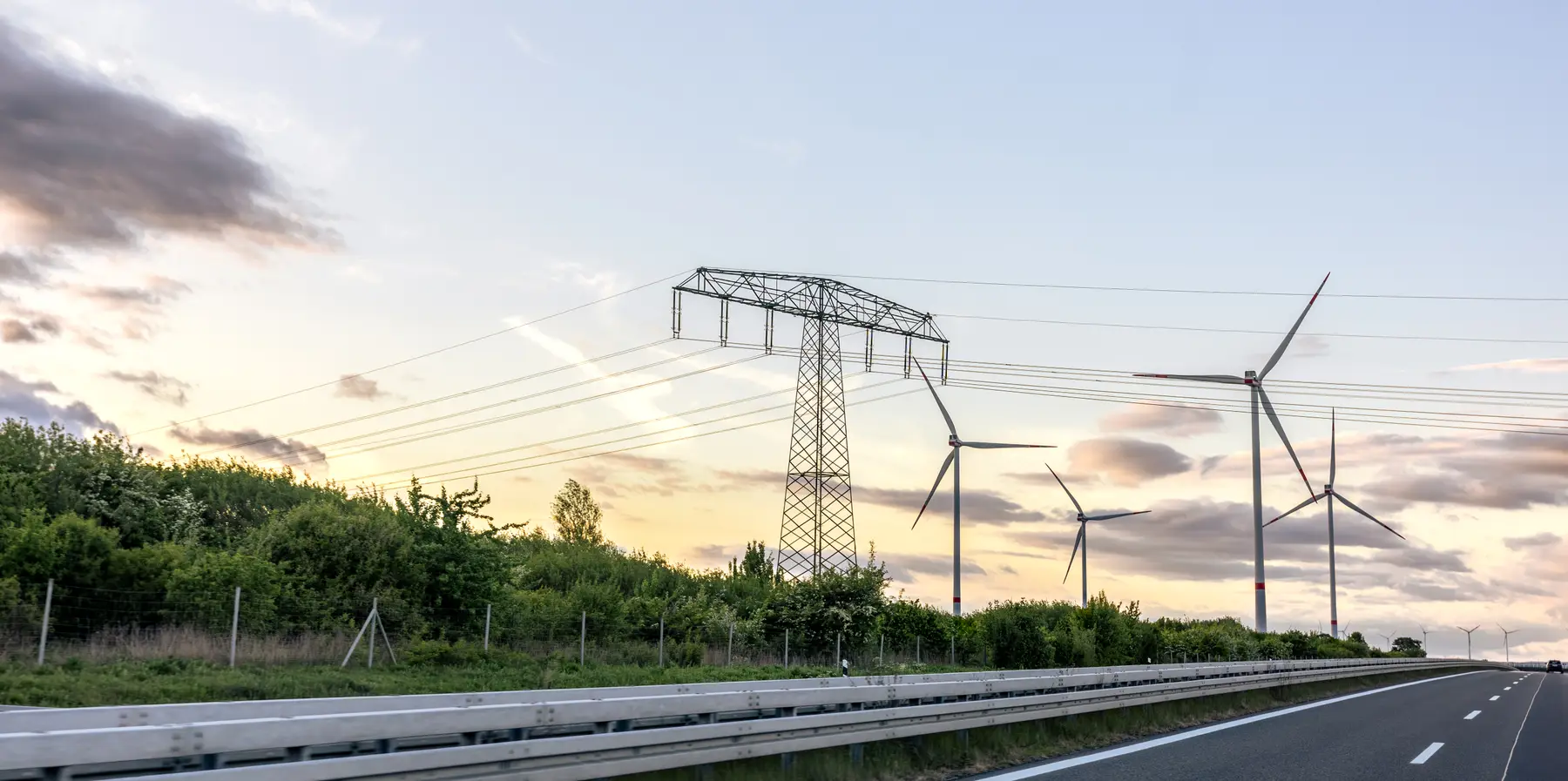
Renewable energy sites are among the most lightning-exposed structures an engineer ever assesses.
A solar farm, wind site or substation sits in the open over a wide area, full of inverters, controllers and monitoring electronics that a surge can destroy in an instant. An IEC 62305 risk assessment, sometimes called a lightning risk evaluation, is how you decide what protection that site genuinely needs, structure by structure, and prove the decision to anyone who asks.
The standard itself does not change for a wind farm or a PV plant; the method is the same one a high-rise or a data centre uses. What changes is the shape of the problem. Renewables put together a large collection area, long internal cable runs and equipment that fails at low surge levels, so the assessment has to model a spread-out site and the lines that tie it together rather than a single box. This guide walks through why these sites are so exposed, what solar, wind and the balance of plant each need, how the risk method scales across many structures, and which protection measures actually move the result.
Why renewables raise the stakes
The same IEC 62305 method applies, but three things about renewable sites push the risk up and make the assessment harder than for an ordinary building.
A large, open footprint
More ground area means more strikes collected over a year, and an exposed rural or elevated site has little around it to take a hit instead. The collection area that drives how often a dangerous event occurs is large by definition.
Sensitive electronics everywhere
Inverters, trackers and controllers fail at low surge levels, far below what a strike can induce, so the protection of internal systems carries real weight in the risk result rather than being an afterthought.
Long internal lines
DC and AC cable runs cross the whole site and carry an induced surge a long way from where the strike actually landed, so the risk components tied to the connected lines matter much more than on a compact site.
Solar farms: a field-sized collection area
A PV plant is, from a lightning point of view, one enormous collection area dotted with vulnerable points. The array itself spreads conductive frames and modules across hectares of open ground, raising the chance that a strike lands on or near the site. The damage rarely stays where the strike lands. Long DC string runs feed combiner boxes, and the boxes feed inverters, and every one of those runs can carry an induced surge from a nearby strike into equipment that was never built to survive it.
The vulnerable points concentrate the risk. Inverters sit between the DC strings on one side and the AC collection network on the other, so a surge can reach them from either direction, which is why they usually need coordinated surge protective devices on both sides. Combiner boxes gather many strings into one point and are an obvious place for protection to sit. Tracker motors, weather stations and the monitoring electronics that report yield are all low-voltage devices strung along the same cable routes. The defence that ties it together is a well-bonded earthing and equipotential system across the whole field, so that when a surge does arrive, every part of the installation rises and falls together rather than developing the voltage differences that destroy equipment.
The assessment for a solar farm therefore leans heavily on the connected-line components and on the coordination of SPDs on the DC and AC sides. It is less about a single tall structure attracting a direct hit and more about a wide, wired field collecting and conducting surges, which is exactly the part of the IEC 62305 method that an ordinary building rarely stresses.
Wind turbines: tall, isolated and struck often
A wind turbine is close to the worst case for lightning exposure: a tall, isolated structure standing alone in open or elevated terrain, which is precisely the geometry that attracts strikes. Tall turbines are struck repeatedly over their working life, and the strike usually arrives at the most awkward possible place, the tip of a rotating composite blade. From there the current has to be led down the blade, through the nacelle and the tower, and into the ground without passing through anything it can destroy.
That path runs through the most expensive and most delicate parts of the machine. Blades carry receptors and an internal down-conductor to capture the strike and carry it inboard. The nacelle houses the generator, converter and control electronics. The current then crosses the main bearing and the pitch and yaw systems, rotating interfaces where leading the current across safely is a real engineering problem, before reaching the tower and the foundation earth. Each of these is a point where a poorly designed path turns a survivable strike into a destroyed component and weeks of lost generation.
This is where a second standard comes in. IEC 61400-24 is the dedicated standard for lightning protection of wind turbines, and it addresses exactly the parts that the general standard does not: blade protection, the down-conductor route through a rotating structure, the bearings, and the pitch and yaw systems. It works alongside the risk thinking of IEC 62305 rather than replacing it. The general standard frames how much protection a structure needs and how to judge the risk; the wind standard sets out how to protect a turbine specifically. A sound turbine assessment uses both together.
Substations and the rest of the site
A renewable plant is far more than its panels or its turbines. The substation that steps the generation up to grid voltage is itself a high-value, surge-sensitive structure, and it is usually the single point through which the whole plant connects to the wider network. Switchgear, transformers and the protection relays around them all sit in the path of any surge that travels in on the collection cables or the incoming grid line.
Behind the high-voltage equipment sits the control side: the control room, the SCADA and protection systems that monitor and operate the plant, and the communications links that report back to the operator. These are low-voltage, high-value electronics doing a job the plant cannot run without, and they are reached by exactly the long internal cable runs that carry induced surges across the site. The assessment has to treat the substation and the control building as their own structures with their own risk, not fold them into a single figure for the plant, because their loss profile, an outage of the whole site, is quite different from the loss of one inverter or one turbine.
Renewables spread the risk across many structures and the lines that tie them together.
The measures that move the result
For renewables, a handful of protection measures do most of the work. The assessment decides which are needed and where, so the spend lands on the structures that carry the risk rather than blanketing the site.
Coordinated SPDs, DC and AC
Surge protective devices sized for the chosen lightning protection level, fitted on both the DC and the AC side and coordinated so each stage hands the surge down to the next. This is usually the single most effective measure on a PV plant, because the surge path runs through the inverters from both directions.
A well-bonded earthing system
An equipotential earthing and bonding network across the whole field gives every surge a low-impedance path to ground and stops dangerous voltage differences building up between structures. Without it the SPDs have nothing solid to refer to.
Shielding and zoning
Routing cables thoughtfully, screening the most sensitive runs and grouping equipment into protection zones reduces the surge that ever reaches the controllers and the SCADA, before any device has to clamp it.
Protection that fits the risk
The assessment is what decides which measures a given structure actually needs. That avoids both the danger of under-protecting an inverter station and the waste of over-specifying protection on a structure that the numbers show is already safe.
How the risk method applies to a whole site
The IEC 62305 risk method does not change for a renewable plant; it is applied more times. Each structure on the site, an inverter station, a control building, the substation, the array, a turbine, is modelled in turn with its own surroundings, its own connected lines and its own loss profile, and the method computes the risks for each. The results then roll up so the plant can be judged as a whole as well as structure by structure. A portfolio of several sites under one owner is the same idea one level higher: many projects, each a collection of structures, assessed on a consistent basis.
What stands out on a spread-out site is the weight of the connected-line components. On a compact building the risk is dominated by direct and nearby strikes; on a renewable plant the long power and data runs between structures mean the components for surges arriving over the lines often carry as much of the risk as the direct strike does. Getting those line lengths, routes and the SPDs that protect them right is the part of the assessment that decides the answer. For the full walk-through of how the components are computed, see how an IEC 62305 assessment works or read the dedicated guide to the IEC 62305-2 risk method.
The compliance and commercial drivers
For a renewable project the assessment is rarely optional. Several forces, regulatory and commercial, push it onto the critical path.
Approval and insurance
An IEC 62305 assessment is commonly required for building or grid-connection approval and demanded by insurers before they will cover a plant. It is the recognised evidence that the lightning decision was made on the numbers, not assumed.
Lender and EPC requirements
Financiers and EPC contracts routinely write the assessment in as a condition of funding or handover, so a missing or weak study can hold up a milestone payment or a project completion.
Downtime cost
A struck inverter or turbine is not just a repair bill; it is days or weeks of lost generation and revenue. The cost of an outage is usually what makes the protection pay for itself many times over.
Warranty
Equipment warranties on inverters and turbines often assume that the surge protection meets the relevant standard. A claim after a strike can turn on whether the protection was specified and documented properly.
A whole portfolio, zone by zone
A renewable site is rarely one structure, and a developer rarely has just one site. Lumex models a plant as a project with many structures and zones under one workspace, so an inverter station, a control room, a substation and the array each carry their own risk and protection, and the picture rolls up to the whole site. A portfolio of plants is handled the same way one level up, so a firm can keep every site on a consistent basis and compare them. The 62305-2 risk method runs exactly as it does for a single building, but across the whole portfolio, with every figure traced back to the clause behind it so an auditor, insurer or lender can follow the reasoning.
This is the kind of work the page for MEP and design firms is built around. New to the standard? Start with what is IEC 62305, then see the Lumex platform for how a portfolio is assessed end to end.
Questions answered
Do solar farms need a lightning risk assessment?
Are wind turbines covered by IEC 62305 or IEC 61400-24?
What surge protection do PV inverters need?
Why are renewable energy sites more exposed to lightning?
How does IEC 62305 apply to a site with many structures?
What protection measures matter most for renewables?
Is lightning protection a compliance requirement for renewable projects?
Does Lumex handle a portfolio of renewable sites?
Lumex computes the IEC 62305-2 method and shows the working. It does not certify a structure. You may not issue or submit a Lumex output until a competent person, qualified where the structure is located, has reviewed the inputs and the result and signed it.
The tolerable risk in IEC 62305-2 is not a fixed constant. Clause 7.3 NOTE 1 gives RT = 1×10⁻⁵ per year as a representative value of tolerable risk and adds that another value may be set once the case has been investigated in detail. Printed p.12 then lets national or local regulations fix RT, the tolerable frequency of damage FT, and the Annex A, B, C and E calculation rules and parameter values. Every Lumex assessment states the jurisdiction it was computed under and the values that applied.