AS 1768 explained: the 2021 standard, section by section
AS 1768:2021 is the Australian standard for lightning protection. Standards Australia published it on 3 December 2021 with six sections and fourteen appendices, and only Appendices D, F and J are normative. It covers risk assessment, protection of structures and equipment, testing and personal safety.
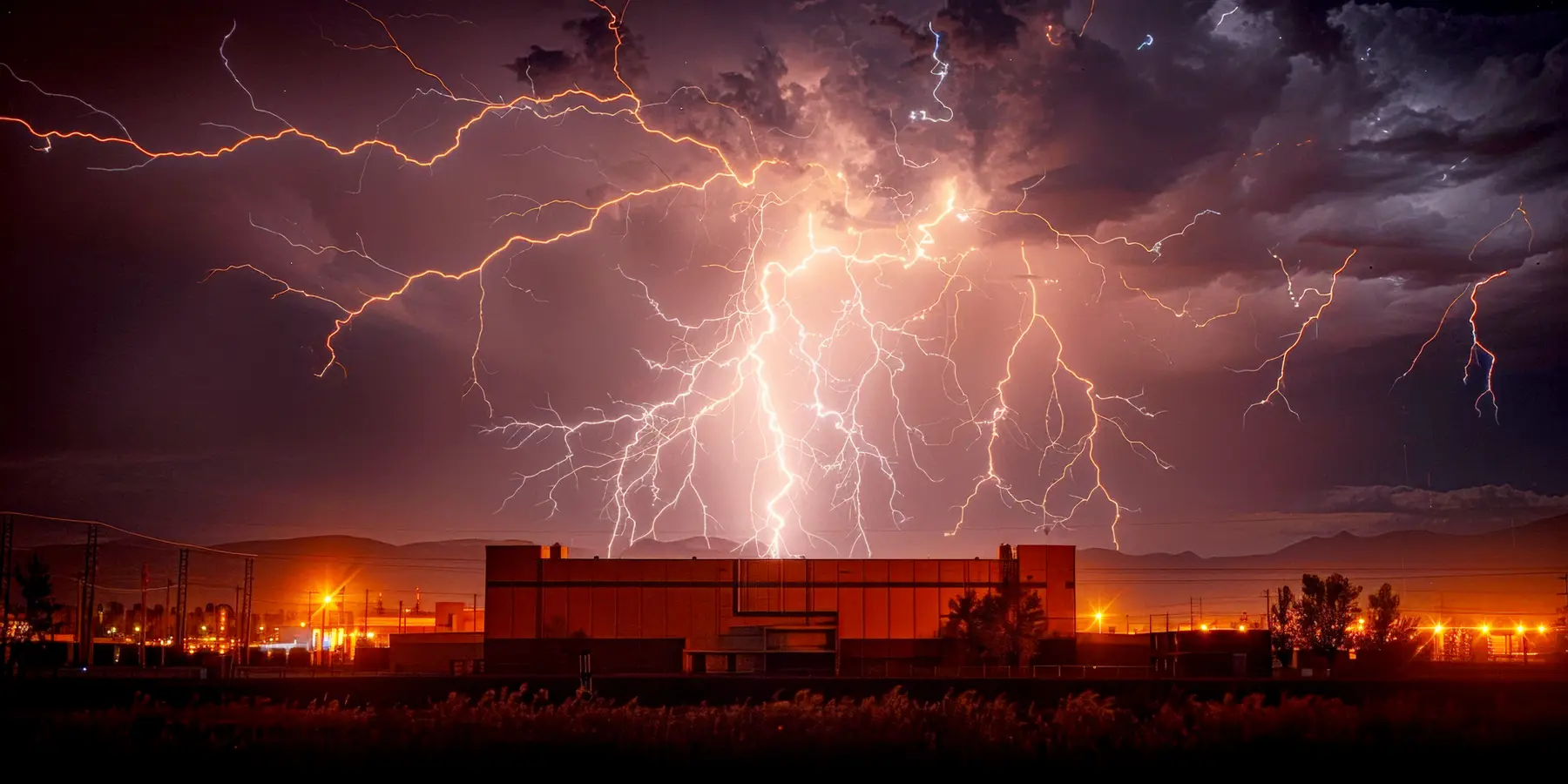
In AS 1768:2021, Section 2 decides whether a structure needs lightning protection, Sections 3 and 4 say how to build it, and Section 5 says how to prove it keeps working.
Committee EL-024 prepared the 2021 edition to supersede AS/NZS 1768:2007, and both national bodies chose to issue it for Australia only (Preface). The Preface also calls it a major revision that moves closer to the IEC standards and accepts that many modern buildings already protect themselves.
Where this guide says "must", the standard says "shall". Where it says "recommends", the standard says "should". Keep two documents ready for any inspector or insurer: the Section 2 risk assessment and the Clause 5.3 site records. To design or certify, you need the purchased copy from Standards Australia.
How AS 1768:2021 is organised
Six sections carry the core requirements. Fourteen appendices add method, detail and special structures. The status column follows the standard's own labels.
| Part | Status | What it covers |
|---|---|---|
| Section 1 | Core | Scope, the conventional systems it covers, referenced documents and definitions |
| Section 2 | Core | Risk assessment: tolerable risk, the risk components and the spreadsheet |
| Section 3 | Core | Protecting structures: air terminals, downconductors, earthing, side flashing, materials |
| Section 4 | Core | Protecting equipment: lightning protection zones and SPD ratings for power and signal lines |
| Section 5 | Core | Testing, records, maintenance and inspection intervals |
| Section 6 | Core | Personal safety outdoors, in pools and indoors, and storm warning systems |
| Appendix A | Informative (guidance) | How lightning forms, its current parameters and what it damages |
| Appendix B | Informative (guidance) | The risk model behind the spreadsheet, adapted from IEC 62305-2 |
| Appendix C | Informative (guidance) | Spreadsheet inputs, the ground flash density map and six case studies |
| Appendix D | Normative | Placing air terminals with the rolling sphere method |
| Appendix E | Informative (guidance) | Earthing for lightning: its purpose, design, construction and testing |
| Appendix F | Normative | Installing SPDs on MEN, TT and IT systems, for power and signal |
| Appendix G | Informative (guidance) | SPD components, how installed SPDs perform, and application examples |
| Appendix H | Informative (guidance) | How large an impulse equipment can withstand, and its immunity to surges |
| Appendix I | Informative (guidance) | Antennas, trees, chimneys, boats, fences, pipelines, houses and small buildings |
| Appendix J | Normative | Extra rules where explosives, flammable gas or vapour, or combustible dust are present |
| Appendix K | Informative (guidance) | Wind turbines: blades, bearings, control systems and earthing |
| Appendix L | Informative (guidance) | High voltage systems above 1 kV: substations, powerlines and power stations |
| Appendix M | Informative (guidance) | Lightning in surface and underground mines |
| Appendix N | Informative (guidance) | Solar PV, with a pointer to AS/NZS 5033 |
The Preface explains the labels: a normative appendix is part of the standard, and an informative one is guidance. Clause 1.1.2 adds one more rule that reaches into Appendix D. To conform, air terminals must be placed as Section 3 requires, whatever performance a product claims.
Who AS 1768 applies to, and what makes it binding
The standard applies to anyone who designs, installs, tests or maintains lightning protection on common structures in Australia, and to the electrical and electronic systems inside them (Clause 1.1.1). That takes in engineers, installers, electricians fitting SPDs, consultants and the owners who keep the system working. It covers conventional systems only. Air terminals that claim enhanced performance, and downconductors that claim better magnetic screening, sit outside its scope (Clause 1.1.2).
A standard does not bind anyone on its own. Standards Australia states that its standards are voluntary until a government refers to them in legislation. In practice, it gains force through a contract, a project specification, a regulator's requirement, or an owner's or insurer's policy. Clause 2.3 also reminds everyone involved that they carry common law and legislative duties to manage safety risks, and it recommends treating lightning risk with the usual hierarchy of controls. For the wider set of Australian documents that bear on a site, see lightning protection standards in Australia.
New Zealand is different. The joint AS/NZS 1768:2007 remains current there, as Standards New Zealand states, so the 2021 text does not carry across the Tasman. Read lightning protection in New Zealand for that position, and the 2007 and 2021 editions compared for what changed.
How Section 2 decides whether protection is needed
Section 2 compares a calculated risk against a tolerable one for each type of loss, then points to the least protection that brings each back within its limit.
Four sources of damage
A flash to the structure (S1), near it (S2), to a connected service (S3) and near a service (S4). Table 2.2 pairs them with eight risk components, RA to RZ, for injury, physical damage and failed internal systems.
A tolerable value per loss
Loss of human life is held to 10⁻⁵ per year. Loss of service to the public is held to 10⁻³. Economic loss starts at 10⁻³. The owner may pick a stricter value (Table 2.1 NOTE), and the spreadsheet also offers looser ones (Clause C.3.2.5.4).
A spreadsheet runs it
The method is a simplified form of IEC 62305-2 with fewer choices, tuned to Australian conditions. The spreadsheet sold with the standard runs it, and Appendix C walks through six case studies.
Figure 2.1 sets out the decision. Work out each component, compare the total for each loss with its tolerable value, and add protection where it is exceeded. A footnote to the figure makes a useful point: when the direct strike components alone stay under the line, surge protection may be enough without a full LPS. Cultural heritage is the awkward case. Table 2.1 prints 10⁻⁴ per year, while the spreadsheet and the worked Figure C.2 apply 10⁻³. Clause 2.2 adds that protection may still be justified whatever the numbers say. For the full method, from inputs to the least protection under Clause C.3.4.2, read how Lumex runs the AS 1768:2021 method.
The AS 1768 map: where to find Ng
The ground flash density map in AS 1768:2021 is Figure C.1, a map of average yearly ground flash density across Australia, on printed page 60. Its source line credits the Bureau of Meteorology, which publishes its own thunder-day and lightning flash density maps online. Clause C.3.1 notes that the risk method needs this map, and Clause A.3 points to the same figure.
Ng is a count of cloud-to-ground flashes per square kilometre per year. You enter the value for the site into the spreadsheet (Clause C.3.2.3). Clause A.3 warns that terrain shifts it: ridges and hills see more strikes than the regional average, nearby valleys fewer. The same value appears elsewhere in the standard. Clause 4.2.1(i) recommends surge protection where Ng exceeds 2 and services arrive overhead, and Tables 4.1 and 4.2 put a service entrance in such an area in their top rating category. For distributed and open-air sites, Clause 2.5.4 multiplies the site area by Ng to estimate how many flashes the whole facility can expect each year.
Protecting the structure
Section 3 sets the physical system: intercept the flash, carry it down, disperse it into the ground, and stop it jumping to anything else on the way.
Air terminals and the rolling sphere
Four protection levels, LPL I to IV, range from 99 % interception at LPL I to 84 % at LPL IV (Table 3.1). Terminals go on points and corners first. A vertical rod must be at least 500 mm long (Clause 3.2.2.2). Appendix D then rolls a sphere over edges, 45 m for LPL III, and a sphere twice that size over large flat roofs. Structures taller than 60 m must also have side strike protection (Clause 3.2.4). See AS 1768 air terminal placement.
Downconductors
At least two, spaced no more than 20 m apart around the perimeter, and never run inside lift shafts or service ducts (Clause 3.3.2). Structural steel, reinforcing and suitable cladding can serve as natural downconductors (Clause 3.3.3), and test points help where a conductor must be tested later.
Earth termination network
The standard recommends 10 ohms or less before bonding other services, and the lowest practical value where the soil will not allow it (Clause 3.5.3). Horizontal electrodes must be buried at least 500 mm deep, and aluminium conductors must never be buried directly (Clauses 3.5.1, 3.5.2). See AS 1768 earthing.
Side flashing and materials
Stop side flashes by bonding metal parts to the LPS or by keeping a separation distance from Equation 3.6.3. Roof plant, balcony rails and incoming gas and water pipes must be bonded (Clause 3.6.2). Conductors must meet the sizes in Table 3.3, and touching metals may differ by at most 0.5 V on the anodic index (Clause 3.7.5).
Clause 2.5.3 closes a loophole worth knowing. The spreadsheet assumes a metal or reinforced concrete building is electrically continuous, earthed and already has adequate air terminations. When it reports that no direct strike protection is needed, you still have to confirm continuity and earthing under Sections 3 and 5 and check that those air terminations exist.
Protecting equipment from surges
Section 4 treats earthing, bonding and surge protection as part of the lightning protection system, not an extra. Whenever an LPS is fitted, incoming metallic and electrical services must be bonded, and for electrical services that bonding is done with SPDs (Clause 4.1). Surge protection is required where the risk assessment calls for it and wherever the facility gets direct strike protection (Clause 4.2.1). It is recommended where Ng exceeds 2 with overhead services, or where a surge could hurt people, cut a public utility or cause unacceptable cost.
This edition replaces the old location categories with lightning protection zones (Clause 4.5). Primary SPDs go at the boundary where services enter, at the main switchboard, and are bonded to the LPS earth where there is one (Clause 4.6.3). Secondary SPDs sit at distribution boards or at the equipment, with a device between neutral and earth as well (Clause 4.6.4). Every SPD must have an upstream overcurrent device, because a temporary overvoltage can destroy it (Clauses 4.4 and 4.6.2). Table 4.1 sets the ratings for power SPDs and Table 4.2 covers signal and data lines. Appendix F, which is normative, shows how to wire them. For the ratings and the wiring in detail, read AS 1768 surge protection.
Testing, records and inspection
Section 5 expects a well built system to need little maintenance, but it still wants proof that it works. The system must be tested during construction, and where parts cannot be inspected later, records and photographs must show how they were installed (Clause 5.2). After that, the standard recommends testing and inspecting at intervals of no more than two years, more often in a corrosive marine setting (Clauses 5.2 and 5.4.4), and an inspection after changes to the system or the building, or after a strike. Clause 5.3 recommends keeping records on site, from drawings and earth readings to SPD indicators. Clause 5.4.3 recommends reassessing the protection when the building changes, for example when solar panels or antennas go on the roof. Every defect found must be recorded and fixed (Clause 5.4.5).
Lightning safety in Australia: what Section 6 advises
Section 6 is the part of the standard written for everyone, not just engineers. It explains how lightning injures people and how to behave when a storm arrives.
How lightning hurts people
Clause 6.2 puts the chance of death at about 5 × 10⁻⁷ per year in Australia, with serious injury ten times more likely. The electrical routes are a direct hit, a side flash from something nearby, touch voltage and step voltage. Thunder can rupture eardrums and the flash can damage eyes (Clause 6.3.3).
Outdoors
The danger is highest once a storm is within 15 km. If you can hear thunder or see lightning, get inside a solid building. Out in the open, a metal-bodied car with a metal roof gives some protection. Keep away from lone trees, fences, water and small open shelters. Wait 30 minutes after the last thunder before going back out.
Pools and indoors
Pools, indoor or outdoor, should name a weather lookout and clear the water when a storm is first noticed. Indoors, skip the bath, shower and landline, stay off mains powered equipment, and unplug appliances that have no surge protection. Mobile and cordless phones are fine.
Clause 6.5 covers lightning detectors and warning systems, classified A to D by how much of a storm's life they can see, with IEC 62793 as the reference. None is fully reliable, and hand-held detectors are the weakest. They add a layer of warning to a protected site. They never replace the protection itself. The risk method in Section 2 does not cover people outdoors (Clause 2.1), so events and open sites rely on these administrative controls.
Special structures in the appendices
Clause 1.1.2 sends particular occupancies to their own appendices. Only Appendix J is normative, and it carries the hardest rules in the standard.
Explosives and hazardous areas
Hazardous area zones and explosive stores. A structure holding explosives must be protected at LPL I, with a 20 m sphere, and masts at least 2 m clear (J.5.1). Surge protection must be part of its LPS (J.5.2). See hazardous site protection.
High voltage systems
Substations, transmission and distribution lines and power stations above 1 kV. It covers surge arrester placement, shielding of lines and a target outage rate for powerlines (Table L.1).
Mines
Surface and underground mines, where lightning can set off explosives, ignite mine gas or carry touch voltages down to workers below. See lightning risk in Australian mines.
Wind turbines and solar PV
Appendix K covers blades, bearings, control systems and turbine earthing. Appendix N is a single page that defers to AS/NZS 5033. See lightning protection for solar PV in Australia.
Specific structures
Guidance for antennas, trees, chimneys, boats, fences, pipelines and small buildings. An antenna inside the zone of protection needs nothing more (I.2.1). A mostly metal house roof can act as the air terminal network, and for a non-metallic roof LPL IV is generally enough (I.10.2).
Background reading
Table A.1 puts the median first stroke peak current at 30 kA. Appendix G covers SPD components and installed performance. Clause H.2 lists impulse withstand levels from 1 500 V for Category I equipment to 6 000 V for Category IV, on supplies of 150 V to 300 V to earth.
Common mistakes when working to AS 1768
Using the spreadsheet on the wrong kind of site. It applies to standalone structures. Treatment plants, mine sites and solar farms are distributed facilities, and golf courses and school grounds are open-air ones. Clause 2.5.4 gives a separate approach for each and applies the spreadsheet only to the individual buildings within them.
Reading "no LPS needed" as "nothing to do". A low result still depends on the continuity, earthing and air terminations the spreadsheet assumed (Clause 2.5.3). Those must be confirmed on site.
Fitting an LPS without surge protection. Clause 4.1 requires incoming services to be bonded whenever an LPS is fitted, and for power and data lines that means SPDs at the point of entry.
Relying on enhanced performance products. Clause 1.1.2 puts them outside the standard, and Clause 3.2.2.2 requires terminals to be placed by the Section 3 rules anyway. A claimed larger protection radius earns nothing.
Working to the 2007 edition in Australia. Old specifications and reports still name AS/NZS 1768:2007. For an Australian site the 2021 edition supersedes it, unless the contract says otherwise. Location categories, for instance, gave way to lightning protection zones (Clause 4.5).
Letting the records lapse. Clause 5.2 requires records and photographs for parts that cannot be inspected later, and Clause 5.3 recommends keeping test results and earth readings on site. Without them, a buried or cast-in system cannot be shown to conform.
What Lumex does with AS 1768:2021
Lumex runs the Section 2 and Appendix B risk method of AS 1768:2021 on Voltrace, the way the Standards Australia spreadsheet runs it. It judges each type of loss against its own tolerable value, finds the least protection under Clause C.3.4.2, shows the working behind every figure with its clause, and produces a report the signing engineer approves. It also sets a review date 24 months out, in line with the two year inspection interval of Clause 5.4.4. Run your site through the Section 2 method at Lumex for AS 1768:2021 before you open Section 3.
Lumex does not design the air terminals, conductors or earthing layout, and it does not certify a structure. Those remain the work of the designer and installer under Sections 3 to 5. Periodic inspection reports are coming soon. Lumex is independent of Standards Australia, and the standard itself must be bought from Standards Australia.
Related reading: how Lumex runs the AS 1768:2021 method, which lightning standard applies to your project, what changed from AS/NZS 1768:2007, the standards map for Australia, placing air terminals under Appendix D, earthing under Appendix E and surge protection under Section 4.
Questions answered
Where does the AS 1768:2021 tolerable risk of 10⁻⁵ come from?
What is AS 1768?
What does the AS 1768:2021 risk assessment leave out?
Can I install lightning protection when the AS 1768 assessment says it is not needed?
Where can I get the AS 1768 ground flash density map?
Is lightning protection mandatory in Australia?
Can I access AS 1768 for free?
How often must a lightning protection system be inspected under AS 1768?
What should you do in a thunderstorm in Australia?
Lumex computes the method of the standard you choose, IEC 62305-2:2024, AS 1768:2021 or NFPA 780-2026, and shows the working. It does not certify a structure. You may not issue or submit a Lumex output until a competent person, qualified where the structure is located, has reviewed the inputs and the result and signed it.
AS 1768:2021 Table 2.1 sets a tolerable value for each type of loss, and the owner chooses the one for economic loss. Every AS 1768 assessment in Lumex states the values that applied.
Get started today