AS 1768 surge protection: where SPDs go and when they are required
AS 1768:2021 requires surge protection when the risk assessment calls for it, whenever a structure has a lightning protection system, and wherever explosive material may be present. SPDs go at lightning protection zone boundaries and are installed to normative Appendix F.
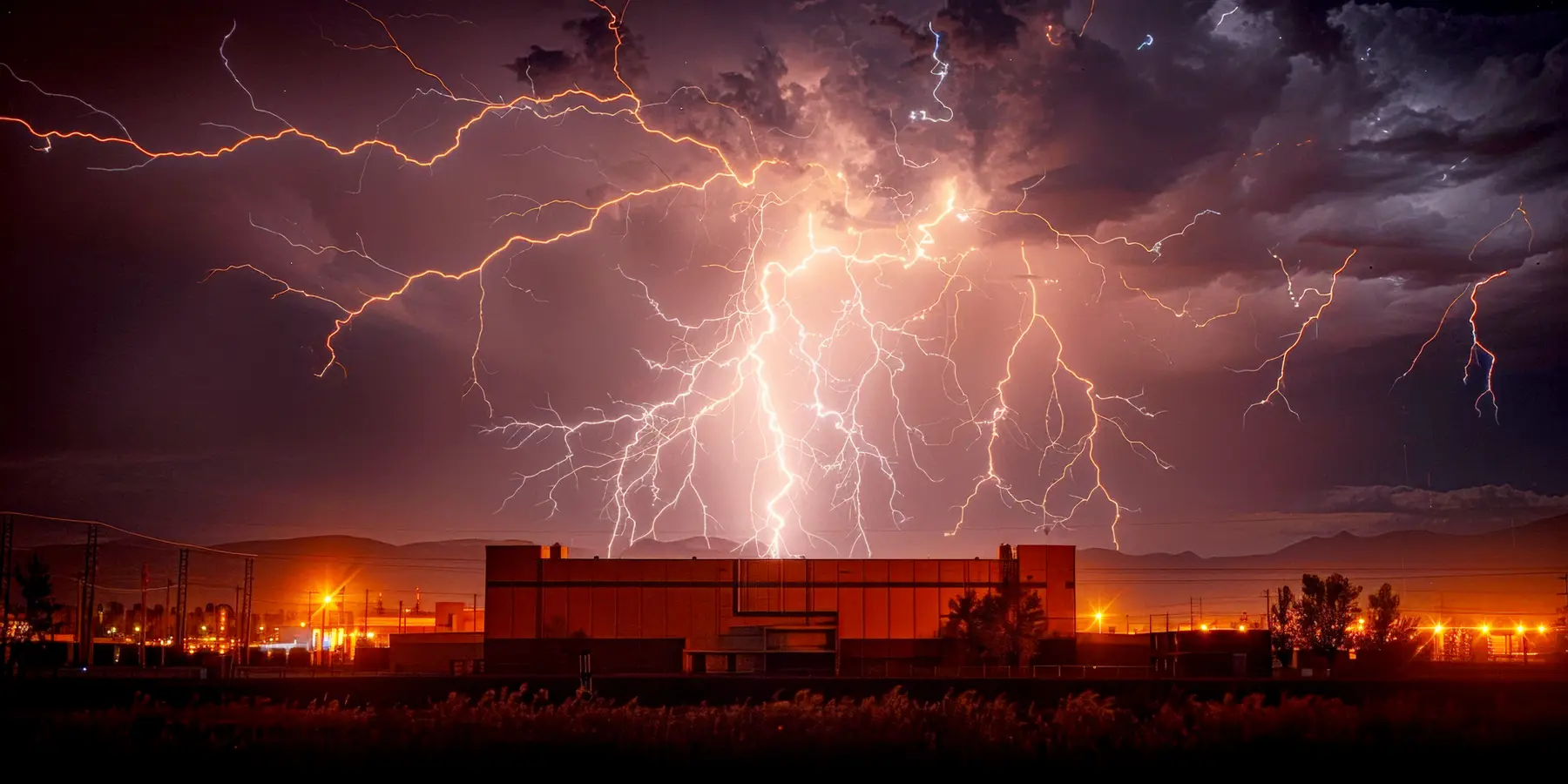
AS 1768 surge protection is the set of rules in Section 4 of AS 1768:2021 for fitting surge protective devices (SPDs) to the power, signal and data lines of a structure, so that lightning surges stop at zone boundaries instead of reaching equipment and people.
A lightning protection system (LPS) keeps a direct strike off the structure, but it does nothing on its own for the wiring. A strike to the building raises its earth potential. A strike to a power line or to the ground nearby pushes a surge down every conductor that comes in. AS 1768:2021 treats earthing, bonding and surge protection as parts of one system (Clause 4.1), and Section 4 is where the SPD rules live.
Checked against AS 1768:2021, September 2026. Lumex is independent of Standards Australia. Buy the standard from Standards Australia to design or certify an installation.
When does AS 1768:2021 require surge protection?
SPDs are mandatory in three cases: the risk assessment calls for them, the structure has an LPS, or explosive material may be present. Four further factors make them advised.
The risk assessment says so
If the Section 2 risk assessment finds that surge measures are needed to bring a risk within its tolerable value, surge protection is a requirement, not an option.
The structure has an LPS
A facility protected from direct strikes must also have surge protection. Clause 4.1 says the same thing another way: with an LPS fitted, incoming electrical services are bonded through SPDs.
The advised cases
SPDs are recommended where Ng is above 2 flashes per km² per year with overhead services, or where surge damage would touch human safety, a public utility, or cost more than the owner can accept.
The third mandatory case is explosives. For any location where explosive material may be present, AS 1768:2021 Clause J.5.2 makes surge protection part of the LPS, installed to Appendix F, with the SPDs placed outside the rooms that hold the material. Clause J.5.6.5 adds SPDs on every incoming electrical, data and control service, overhead or underground.
What an SPD protects against
AS 1768:2021 separates two kinds of overvoltage, and an SPD is built for only one of them.
Transient overvoltages are what lightning causes (Clause 4.3): a strike on the LPS lifts the earth potential, current flows in along a service conductor, or a nearby strike induces a surge in the incoming lines. The answer is earthing and bonding under Section 3 plus SPDs whose voltage protection level Up stays below what damages the equipment.
Temporary overvoltages (TOVs) come from the power system itself: poor regulation, a lost neutral, capacitor switching, a fault on the low or high voltage network (Clause 4.4). They last far longer than a lightning surge, typically 0.2 s up to 5 s, and on the MEN system a low voltage fault can lift the voltage to about 1.7 times nominal. A TOV can destroy an SPD. That is why the standard requires every SPD to have an upstream overcurrent device able to isolate it.
Clause 4.2.2 sorts SPDs into voltage limiting types such as varistors, voltage switching types such as spark gaps and gas discharge tubes, and combinations of both, and into one-port and two-port devices.
Lightning protection zones decide where SPDs go
The 2021 edition replaced the old lightning location categories with lightning protection zones (LPZ). An SPD belongs wherever a conductor crosses a zone boundary.
The outside zones
LPZ0A is exposed to direct flashes and the full field of the strike. LPZ0B is shielded from direct flashes but still sees the full field. The rolling sphere draws the line between the two.
The inside zones
In LPZ1 the surge current is already reduced by current sharing, isolating interfaces or SPDs at the boundary. Each zone further in, LPZ2 onwards, can reduce it again with more SPDs or shielding.
Clause 4.5 also names four sources of strike, S1 to S4: a flash to the structure, near the structure, to a connected service, and near a connected service. They match the columns of Table 2.2 in the risk assessment, which is how the surge rules and the risk figures stay aligned. Primary SPDs are required at LPZ0A/1 and LPZ0B/1 boundaries. Part of the direct lightning current can reach them, so they may carry 10/350 µs ratings as well as 8/20 µs ratings. Secondary SPDs at LPZ1/2 and deeper are required when the risk assessment or the Clause 4.2.1(i) to (iv) factors call for them.
Where each SPD goes, and what puts it there
A location summary written in our own words from Section 4 and Appendix C. The rating ranges for each row are in AS 1768:2021 Tables 4.1 and 4.2.
| Zone boundary | Where the SPD sits | What makes it required | Source |
|---|---|---|---|
| LPZ0A/1 or LPZ0B/1, power | Main switchboard, between each phase and neutral, and any distribution board whose cabling leaves the structure | An LPS on the structure, or a risk assessment that needs point of entry surge protection | 4.2.1, 4.5, 4.6.3(b), (d), (g); C.3.4.2(c) |
| LPZ0A/1 or LPZ0B/1, signal and data | Where the line first terminates, or near the protected equipment | The same triggers as power, with the line's exposure setting the rating | 4.7(b); Table 4.2 |
| LPZ1/2 and deeper, power | Distribution board or the equipment, phase to neutral plus neutral to earth | A risk assessment that still fails with point of entry protection alone, or the 4.2.1(i) to (iv) factors | 4.5, 4.6.4(b), (d); C.3.4.2(d) |
| LPZ1 and deeper, signal | Marshalling cubicle or equipment cabinet | Advised for sensitive equipment, runs over about 10 m from the entrance SPD, or internal switching sources | Table 4.2; G.3(b) |
| Explosives store | All incoming electrical, data and control services, outside the rooms holding the material | Always, whatever the risk figures say | J.5.2, J.5.6.5 |
Table 4.1 keys power ratings to the zone boundary and a location category, A to C3, kept from earlier editions (note a). Category C3, a service entrance on a building with an LPS or where Ng exceeds 2, lists an Imax of 100 kA, an In of 40 kA and an Iimp of 10 kA per phase, and note b suggests going higher in tropical and mountaintop sites. An SPD meeting any one listed rating is deemed to conform.
The power SPD rules, primary and secondary
The power SPD rules in AS 1768:2021 are written for the MEN (TN-C-S) wiring system defined in AS/NZS 3000, and other wiring systems are handled in Appendix F (Clause 4.6.1). Three rules apply to every power SPD.
Overcurrent protection comes first. Each SPD needs an upstream device that protects it against short circuit (Clause 4.6.2). Together, the SPD and that device must withstand the prospective short circuit current at that point. The backup fuse must discriminate with the supply authority's fuse. It must never exceed the maker's maximum backup rating.
SPDs go ahead of RCDs where possible. Where they cannot, Clause 4.6.2 suggests type S RCDs, and Clause F.3 asks for a breaking capacity of at least 3 kA on an RCD with an SPD on its load side.
Up must sit below what harms the equipment. Both primary and secondary SPDs carry this rule (Clauses 4.6.3(h) and 4.6.4(e)), with Appendix H as the guide to what equipment can take.
Primary SPDs are installed at the main switchboard, between each phase and neutral, rated to Table 4.1, and at any distribution board whose cabling runs out of the structure where lightning can reach it (Clause 4.6.3). Where the structure has an LPS, the SPD earth connects to the LPS earth network. A combination or two-port device that gives both primary and secondary protection is installed under the primary rules.
Secondary SPDs go at a distribution board or at the protected equipment (Clause 4.6.4). Because a distribution board has no MEN link of its own, they are fitted phase to neutral and also neutral to earth, preferably with a voltage switching part on the neutral to earth path. That pairing gives both common mode and differential mode protection.
Signal, data and telecommunications lines
Signal SPDs follow the same zone logic as power SPDs (Clause 4.7). They are rated to Table 4.2 and installed where the line first terminates or as near to the equipment as practicable. Where they earth to a dedicated signal earth, that earth is bonded to the site earths under Clause 3.5.2(a).
Table 4.2 rates signal SPDs by total discharge current ITOT (8/20 µs) and by Iimp (10/350 µs), and again deems a device conforming if it meets either one. Its note explains that most signal lines are pairs protected first by gas discharge tubes, so the ratings refer to both lines together to earth. At a point of entry with long overhead or underground signal cables, or on a building in a high lightning area or fitted with an LPS, the table lists 10 to 20 kA ITOT and 1 to 2.5 kA Iimp.
For telecommunications SPDs on customer cabling, AS 1768:2021 refers you to AS/CA S009 (Clause G.5.2 NOTE 2), and it wants the mains and signal entrance SPDs bonded to the main earth bar within 1.5 m (Clause G.5.1 NOTE).
How Appendix F wants SPDs installed
Appendix F is normative, so its "shall" rules are requirements; its "should" rules, such as the 1 m lead length, are recommendations. It covers each earthing arrangement in turn.
MEN main switchboard
One-port SPDs between each phase and neutral, protected per Clause 4.6.2, wired to AS/NZS 3008.1.1. With the MEN link already joining neutral and earth there, the phase to neutral mode is the one that matters (G.3(a)).
Distribution boards
Phase to neutral and neutral to earth, because the only MEN link is back at the main board. The neutral to earth part is usually a voltage switching device, which stops earth leakage current.
TT systems
No neutral to earth link in the main board, so the entrance needs the extra path too: a 1+1 arrangement on single phase and 3+1 on three phase.
IT systems
Each phase connects through an SPD to a common point tied to the neutral, with one component from that point to earth. On a delta supply the note allows three phase to earth SPDs rated for line to line voltage.
Two-port SPDs
Wired in series after the main switch, behind an overcurrent device rated no higher than the SPD's load current IL. A separate SPD neutral bar is the recommended layout because it keeps the shunt neutral from adding to Up.
Equipment rooms and cabinets
Every external cable entering the room or cabinet is protected, power and signal alike, and all its SPDs share one earth reference, normally the cabinet frame, bonded to the supply earth.
One recommendation repeats in Clauses F.2 to F.5: keep each shunt SPD's connections short and direct, within 1 m of conductor in total, and add secondary protection on sensitive circuits where that cannot be met.
Why lead length, coordination and equipment withstand matter
Appendix G is the engineering background to AS 1768 surge protection. It compares gas discharge tubes, spark gaps, varistors and suppression diodes, including why a gas discharge tube suits neutral to earth but not phase to neutral (Clause G.2).
Its most useful lesson is about lead length (Clause G.4). The inductance of the wires to a shunt SPD adds a voltage on top of the device's own Up. The standard's rule of thumb is about 1 kV for an SPD carrying 10 kA through 1 m of lead. In its measured example, an SPD with an Up of 900 V at its terminals reached 1,500 V with 0.5 m of lead, 2,100 V with 1 m and 3,200 V with 2 m. A second comparison (Figure G.5) puts a two-port SPD with an LC filter at an Up of 200 V against the one-port device's 900 V. That is why the 1 m limit in Appendix F matters.
Appendix G also covers coordination between a primary and a secondary SPD. The primary handles the bulk energy. The secondary, close to the equipment, is chosen for a low Up. Where the cable run between the two is shorter than about 10 m to 20 m, some devices need an added series inductor, so check with the maker, or use a two-port SPD instead (Clause G.3(d)). Secondary protection is worth considering where sensitive equipment sits more than about 10 m from the entrance SPD (Clause G.3(b)).
Appendix H covers how much surge a.c. equipment can take. It summarises the IEC 60664-1 overvoltage categories for installations above 150 V and up to 300 V phase to earth: 6,000 V for Category IV equipment at the origin of the installation, 4,000 V for Category III, 2,500 V for Category II and 1,500 V for Category I. Not knowing what will be plugged in, it suggests main switchboard SPDs that hold overvoltages to Category I levels (Clause H.2), balanced against good TOV withstand (Clause H.3).
How surge protection feeds the risk assessment
In AS 1768:2021 the risk assessment does not size an SPD. It decides which surge measures are needed. Figure 2.1 shows the logic: if the risk is over its tolerable value and the direct flash components are already acceptable, surge protection measures alone can be enough and a complete LPS is not needed.
Appendix B splits each risk into a direct part, Rd, from flashes to the structure, and an indirect part, Ri, from flashes near it and to or near its services (equation B.3.1(1)). Clause B.4.3 deals with the case where Rd is within the tolerable value but Ri is not. It names two measures: SPDs on every external service at the point of entry, and SPDs on all internal equipment. The calculation is repeated with one or both in place until Ri is acceptable. If neither works, shielding of equipment or screened cables come next.
Clause C.3.4.2 turns this into an order of work: settle fire protection, try LPL IV upward, then add surge protection at the point of entry, then at the equipment, lowering the LPL as far as each step allows. In the worked examples, the two storey house (Clause C.3.8) needs no LPS but does need AS 1768 surge protection because of its exposed service line, and the remote pump station (Clause C.3.7) needs primary and secondary protection, which one two-port SPD can give on a small site.
The risk assessment can show point of entry protection is enough while secondary protection is still worth fitting. In the Brisbane office block case study, the standard recommends considering it for server rooms, rooftop plant rooms and the sub-distribution boards on each floor (Clause C.3.4.3). The risk figures choose the measure, while Section 4 and Appendix F still set the rating and the wiring. For how Lumex runs this search, see how the AS 1768 risk assessment works in Lumex.
Common mistakes, and what an inspection checks
Long, looping SPD leads
A well rated SPD on 2 m of looping cable can let through several times its rated Up. Keep each SPD's leads within the 1 m of Appendix F, run them together, and bond entrance SPDs to the main earth bar within 1.5 m.
An LPS with no surge protection
Air terminals and downconductors alone leave the building non-compliant. Clauses 4.1 and 4.2.1(b) call for SPDs on incoming services whenever an LPS is fitted, with the SPD earth tied to the LPS earth.
Power protected, signals forgotten
Data, control and telecommunications lines cross the same zone boundaries as power. Clause 4.7 and Clause F.7 want every external cable into an equipment space protected to a common earth.
No backup protection, or the wrong one
An SPD without an upstream overcurrent device can fail dangerously under a TOV. The backup must discriminate with the supply fuse and stay within the maker's maximum (Clauses 4.4 and 4.6.2).
Section 5 of AS 1768:2021 treats SPDs as part of the LPS. What it recommends an inspection covers:
- Each SPD inspected as part of the LPS (Clause 5.2).
- Condition indicator readings for every SPD, kept with the inspection records (Clause 5.3(g))
- The upstream overcurrent device (Clause 5.4.2(e))
- Inspections no more than two years apart (Clause 5.4.4).
- A reassessment when the electrical or computing facilities change (Clause 5.4.3).
The surge decision, worked and shown
Lumex's Voltrace engine runs the AS 1768:2021 risk assessment. It judges R1 to R4 each against its own tolerable value and then searches for the least protection that clears all four, following Clause C.3.4.2. The search tries surge protection at the point of entry, at the equipment, and both, and the report shows the risk each package leaves.
Because Clauses 4.1 and 4.2.1(b) tie surge protection to every LPS, the search never offers an LPS without point of entry SPDs where a service comes in, and warns you if the protection you declared breaks that rule. For an explosives store it looks only at packages that meet Clauses J.5.1 and J.5.2.
Lumex does not design the SPD scheme, choose ratings from Tables 4.1 and 4.2, or certify an installation. It sets a review-due date and reminder, 24 months for AS 1768.
Run your structure through the AS 1768 risk assessment to see whether point of entry protection is enough.
Related reading:
- AS 1768:2021 explained: the standard as a whole.
- AS/NZS 1768:2007 vs AS 1768:2021: what the 2021 edition changed.
- AS 1768 earthing: the earth network SPDs bond to.
- AS 1768 air terminal placement: where air terminals go.
- Lightning protection for solar PV in Australia: surge protection for arrays.
- Australian lightning protection standards: the full map.
- SPD types under IEC 62305: the international view of SPD classes.
- The standards overview: which standard applies to your project.
Questions answered
What is the Australian standard for surge protection against lightning?
When does AS 1768 require SPDs?
Where are SPDs installed under AS 1768?
What SPD rating does AS 1768:2021 require at a service entrance?
Is a lightning protection system without SPDs compliant with AS 1768?
What is the difference between primary and secondary SPDs in AS 1768?
How long can SPD connecting leads be under AS 1768?
Does the AS 1768 risk assessment decide the surge protection?
Lumex computes the method of the standard you choose, IEC 62305-2:2024, AS 1768:2021 or NFPA 780-2026, and shows the working. It does not certify a structure. You may not issue or submit a Lumex output until a competent person, qualified where the structure is located, has reviewed the inputs and the result and signed it.
AS 1768:2021 Table 2.1 sets a tolerable value for each type of loss, and the owner chooses the one for economic loss. Every AS 1768 assessment in Lumex states the values that applied.
Get started today