Lightning protection for mines in Australia: AS 1768 Appendix M and the regulators
A mine faces lightning hazards an office block never does: explosives, flammable gas, huge mobile plant and conductive paths that run underground. This guide sets out what AS 1768:2021 recommends for surface and underground mines, what it requires for explosives stores, and what the Queensland and Western Australian regulators have added.
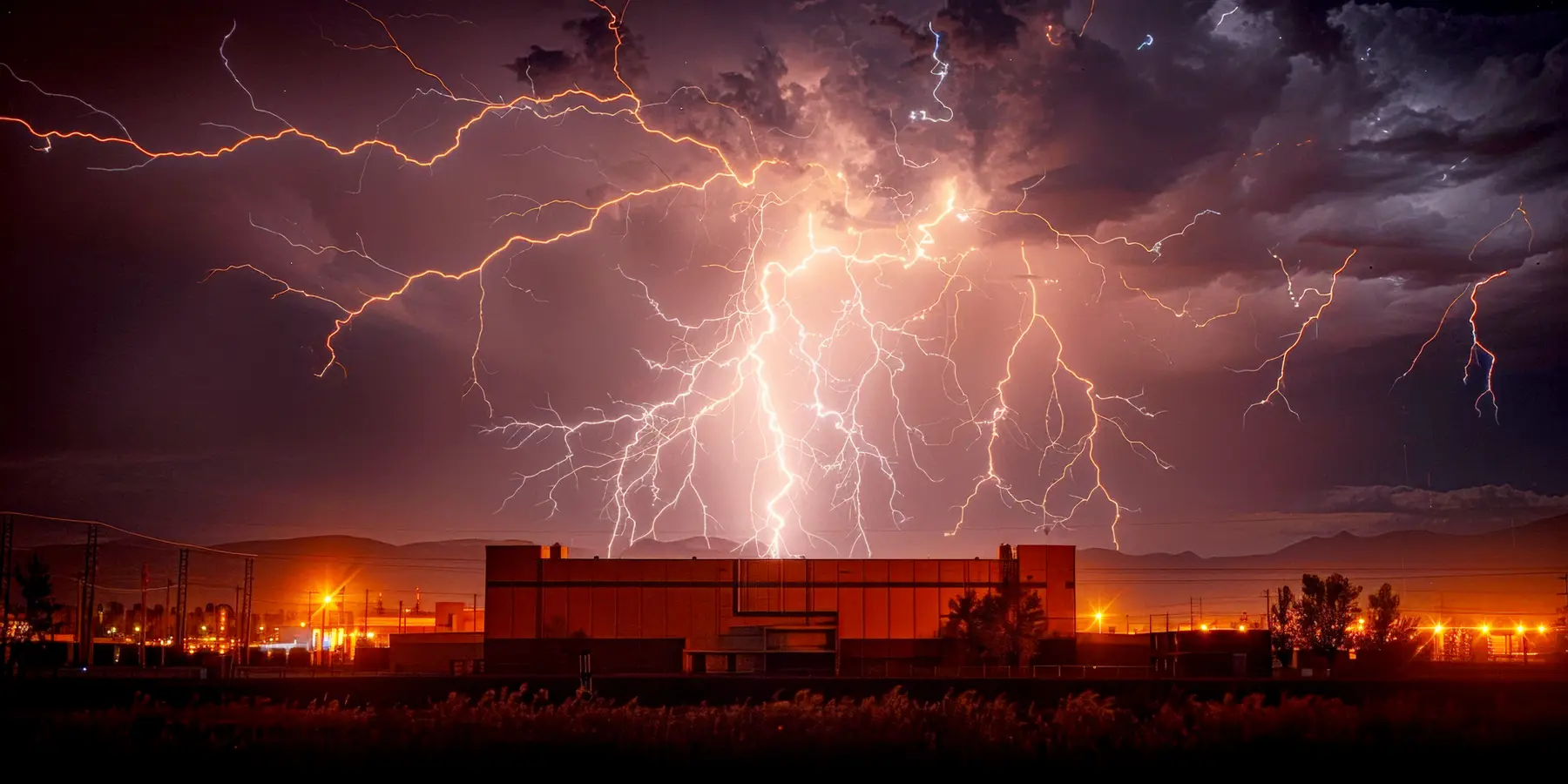
Lightning protection for mines in Australia draws on two parts of AS 1768:2021: informative Appendix M for the mine as a whole, and normative Appendix J for any store of explosives, backed by guidance from the state mines regulators.
On a mine, lightning can set off explosives, ignite methane underground, travel along a conveyor or a borehole casing into the workings, and make a haul truck tyre explode up to a day after the strike. That is why AS 1768:2021, the Australian lightning protection standard from Standards Australia, gives mines an appendix of their own.
To design or certify a system you need the purchased standard from Standards Australia, and your duties on site come from your state's mining safety law. This guide draws on AS 1768:2021, RSHQ Bulletin 205 (2022), RSHQ Alert 462 (2025) and WorkSafe WA Mines Safety Bulletin 183 (2025).
Does AS 1768 cover mines?
Yes, in three places. Appendix M gives the mine specific guidance, Appendix J sets binding rules for explosives, and Clause 2.5.4 explains why the risk spreadsheet cannot assess the whole site at once.
Informative guidance
Clause 1.1.2 of AS 1768:2021 points to Appendix M for lightning risk in mines. It covers surface mines, surface structures and underground mines. Being informative, its wording is advice rather than a condition of conformance, but your safety management system may still adopt it.
Normative rules for explosives
Appendix J covers structures with a risk of explosion, from flammable gas and dust zones to magazines. It is normative, so its requirements are part of the standard. A mine magazine, a bulk explosives store or a designated open storage area all fall under J.5.
A distributed facility
A mine site is named as a distributed facility: separate structures joined by conductive services inside one boundary. The spreadsheet assesses standalone structures only, so the site gets a coarser treatment and each building gets its own assessment.
The whole-site method in Clause 2.5.4.2: multiply the area inside the boundary by the ground flash density Ng to estimate flashes to the site each year, and if a strike is likely during the site's life, choose controls by the hierarchy in Clause 2.3. Then run the spreadsheet on each standalone structure, and protect the cables and equipment linking them to Section 4.
Why lightning is a bigger hazard on a mine
AS 1768:2021 Clause M.2 names three hazards that a mine adds to the ordinary list. Explosives can detonate early, either from a direct flash or through current induced in an electric detonator circuit. Flammable mine gas can ignite. And mining infrastructure can carry a dangerous touch voltage to places far from the strike, most seriously to underground workings where nobody can see or hear the storm.
For underground mines the clause asks you to weigh the soil resistivity above the workings, the depth of cover, who is working below, whether gas or explosives are present, and what conductive paths connect the surface to the workings. Its NOTE warns that shallow mines and high resistivity ground carry more risk, because current spreads further through poorly conducting soil. For surface operations, the clause points to large mobile earthmoving machines and to tall fixed plant such as winders, conveyors and bins, as well as draglines, drills and shovels with long booms or masts.
What should a mine lightning management plan cover?
A mine lightning management plan (LMP) should identify the lightning hazards across the whole site, describe the controls in place for each, and set out what happens in every phase of a storm, from the first warning to the all clear. That risk based plan is the central recommendation of AS 1768:2021 Appendix M, set out in Clause M.2. Clause M.4 extends the plan to surface structures, from processing plant to offices and accommodation.
Detection and warning belong inside the plan. Clause 6.5 separates detectors, which sense the radio burst of a flash already made, from warning systems, which watch the electric field and can alert before the first flash. It grades them in classes A to D, refers to IEC 62793, and warns that none is fully reliable, hand-held units least of all. Its NOTE adds that these systems lower the overall risk but never stand in for the protection system itself. Clause M.6 points mines to the same clause.
Clause 6.4.1 sets a baseline: people outdoors are most at risk once a storm is within 15 km, and a retreating storm stops counting as a threat 30 minutes after the last thunder. Mine trigger plans often use several distance bands instead, as the Queensland alert below shows.
What do surface mines do when a storm approaches?
AS 1768:2021 Clauses M.3.1 to M.3.4 recommend that they stop blasting, clear people from explosives areas, keep hands off cables and pipework, and follow a planned response for mobile plant and its tyres.
Blasting when a storm approaches
Stop laying and firing, withdraw people, and set an exclusion zone around every area holding explosives, sized by a risk assessment of what an unplanned detonation would do. The NOTE warns that a storm front can put a ground flash 10 km or more away. Move drills, shovels and draglines out of the zone too, because tall equipment may attract more lightning.
Hands off cables and pipework
During a storm, nobody should handle power or communication cables, trailing cables of mobile machines, overhead lines, conductive pipes or other metalwork where a hazardous voltage could be transferred, even when the cable is switched off.
Mobile plant scenarios
The LMP should plan for operating, maintaining and leaving mobile plant during a storm, and for a strike to a machine with or without people aboard. The standard leaves the controls to the mine's own risk management process.
Tyre pyrolysis and explosions
Heat from a strike can break down tyre rubber into flammable gas that explodes without visible fire, at once or up to 24 h later. Mines should consider an LPS over park up areas for large rubber-tyred machines, consider nitrogen fill or similar measures, and have a procedure for a tyre suspected of being at risk.
Clause M.4 covers surface buildings. The plan should state which plant must run through a storm, how people are warned, how they move between buildings, and which structures are fit to shelter in, judged on lightning protection and on stability in high wind.
Underground mines: how lightning gets below ground
AS 1768:2021 Clause M.5.1 asks planners to consider gas layers, gas in sealed goaf, unsealed goaf fringes, surface gas drainage plant linked to the workings, and unintended operation of equipment or explosives. Workers below may not know a storm is overhead, so surface controls should be designed to eliminate, or at least reduce, the lightning energy that reaches the workings.
Energy travels down four ways: through boreholes; along conveyors, pipes, cables, vent shafts, mesh and reinforced portals; through the strata from a ground flash; and by coupling into long conductors, live or not.
Know every connection (M.5.2). Keep survey records of each entry point: lined or instrumented boreholes, conveyors and steel cord belts, cables, rails, pipelines, lined vent shafts and winders.
Break the path (M.5.3). Insulated sections in pipes and conveyors, fibre optic links and separated cable screens interrupt the route to the seam. Line the breaks up rather than staggering them, so differently earthed items cannot put a hand to hand voltage across a worker, and signpost each zone.
Design the earthing early (M.5.4).
- Design lightning protection and mine earthing together at the civil design stage, taking in AS 2067, AS/NZS 3007 and AS/NZS 3000 as the clause directs, from a three dimensional soil resistivity model, aiming for risk as low as reasonably practicable.
- Past practice kept the lightning earth at least 15 m below ground and 3 m through the air from the mine underground earthing system. The clause asks for a distance calculated for the site instead.
- Where isolation fails, as at winders, shunt the energy into the ground away from the workings. Earth every non-power conductor entering the workings deliberately, never through chains.
- Overhead supply lines within 1.5 km should carry overhead earth wires, with surge arresters at their ends.
Boreholes (M.5.5, M.5.6).
- A study should decide whether a borehole needs an LPS or its own earth.
- The same study decides whether the casing is insulated, bonded or kept apart from the mesh.
- Decommissioning plans for a retired borehole should consider removing or ending its conductive casing at least 6 m below ground, and taking out its cables and pipes.
In the workings (M.5.7).
- Coal mines should consider gaps or non-conducting mesh at chosen points, knowing current can bypass a gap through the strata.
- Remove conductors from sealed areas where possible, and break anything crossing a goaf seal.
- Stop underground blasting when storms are forecast, and use detonators designed to resist electrical discharge.
Mine lightning controls and where each comes from
The source column names the AS 1768:2021 clause or regulator document behind each row. Appendix M rows are guidance; Appendix J rows are requirements unless noted.
| Control | Applies to | Source |
|---|---|---|
| Risk based lightning management plan with detection and warning built in | Whole site | AS 1768:2021 M.2, 6.5, M.6 |
| Estimate site strikes from boundary area and Ng, then assess each structure | Whole site | AS 1768:2021 2.5.4.2 |
| Suspend blasting, withdraw people, set a risk based exclusion zone | Surface blasting | AS 1768:2021 M.3.1 |
| No handling of cables, lines or pipework during a storm | Surface | AS 1768:2021 M.3.2 |
| Consider an LPS over park up areas and nitrogen fill against pyrolysis | Haul trucks and large tyred plant | AS 1768:2021 M.3.4 |
| Park up non-autonomous heavy mobile equipment once lightning is within 16 km | Queensland surface mines | RSHQ Alert 462 (2025) |
| Cease work and move people to a protected shelter as the preferred control | Queensland operations | RSHQ Bulletin 205 (2022) |
| Survey records of every conductive path to the workings | Underground | AS 1768:2021 M.5.2 |
| Aligned, signposted non-conductive breaks in pipes, conveyors and cables | Underground | AS 1768:2021 M.5.3 |
| Integrated earthing design, separation calculated for the site | Underground | AS 1768:2021 M.5.4 |
| Overhead earth wires within 1.5 km, surge arresters at line ends | Supply lines | AS 1768:2021 M.5.4(k) |
| Borehole lightning study; consider ending retired casings 6 m below ground | Boreholes | AS 1768:2021 M.5.5, M.5.6 |
| LPL I protection with 2 m clearance for masts and air terminals | Explosives stores | AS 1768:2021 J.5.1 (required) |
| SPDs as part of the LPS, fitted outside the storage area | Explosives stores | AS 1768:2021 J.5.2 (required) |
| Earth termination network of 10 ohms or less | Explosives stores | AS 1768:2021 J.5.6.1 (recommended) |
Do explosives magazines need lightning protection?
Yes, and here the standard stops advising and starts requiring. AS 1768:2021 Clause J.5.1 says any building that keeps explosive substances or articles must be protected, using one of three methods: roof protection to Section 3, several masts or a suspended air terminal network, or a single vertical air terminal for a small structure or magazine. LPL I applies in all cases, which the clause ties to a 20 m rolling sphere. Masts and air terminals must stand at least 2 m clear of the store, and the store's own fabric may not form part of the LPS unless that cannot ignite its contents.
J.5.1 reaches beyond the magazine: buildings within 50 m with their own fire or explosion hazard, buildings within 30 m that could throw masonry onto the store or start a fire if struck, and any open area designated for storing explosives all need protection too.
Surge protection (J.5.2). SPDs are required as part of the LPS wherever explosive material may be present, installed to Appendix F and placed outside the area where the material is held. Where power comes from an overhead line, J.5.6.5 requires a buried cable section before the point of entry and SPDs at the end of the overhead line, as well as SPDs on every incoming power, data and control service.
Buried and mounded stores (J.5.3, J.5.4). A buried store with at least 500 mm of cover and no services from above may use a surface mesh of 3 m to 8 m. A mounded store with less than 500 mm of cover is protected to Section 3.
Earthing and bonding (J.5.6). A ring conductor should link the earth terminations, and it must be buried at least 500 mm deep and at least 1 m from the walls unless bonding, testing or corrosion reasons justify leaving it exposed. The network should be 10 ohms or less, a recommendation inside a normative appendix. Racking, incoming services, and fences at no more than 10 m spacing are bonded, and no unprotected mast, antenna or tree may stand within 15 m.
Appendix J also covers gas and dust hazardous areas in J.3, relevant to coal handling and gas drainage plant; the hazardous area guide explains those zone rules.
What the Queensland and Western Australian regulators say
On a mine, what binds you is your state's mining safety law and the safety and health management system built under it. The regulators' lightning guidance sits beside AS 1768:2021 and in places goes further.
Resources Safety and Health Queensland, Bulletin 205 (7 October 2022). Risk management during lightning events ranks ten vehicle hazards in lightning, rating voltage near a vehicle, open ground and tyre pyrolysis highest. Its preferred control is to stop work, park vehicles and keep people in a shelter protected to an industrial standard such as AS 1768:2021. It did not then treat nitrogen fill as reliable.
RSHQ Alert 462 (4 November 2025). Court ruling: lightning hazards reports that the Industrial Court, in BM Alliance Coal Operations Pty Ltd v le Roux (No 2) [2024] ICQ 20, a decision the Court of Appeal of Queensland has since confirmed, found that operating non-autonomous heavy mobile equipment with lightning within 16 km was an unacceptable risk even with nitrogen filled tyres, because operators touch pedals and controls that conduct. The mine's triggers were 60 to 30 km, 30 to 16 km, and under 16 km. The alert encourages tyres kept above 95% nitrogen, asks mines without them to move people to a secure building before lightning reaches 30 km, and still prefers a protected building to waiting in a cab.
WorkSafe WA, Mines Safety Bulletin 183 (18 March 2025). Hazard of lightning strikes on vehicles reports several vehicles struck on WA mining operations over three years, some of them later suffering tyre pyrolysis, and says haul trucks and other heavy vehicles are not designed to protect occupants from a strike.
Both Queensland notices say they are a guide only, not a statement of law. Read them alongside the standard: AS 1768:2021 M.3.4 asks you to consider nitrogen, while Queensland now says nitrogen reduces one risk but does not make operating in close lightning acceptable.
If your mine is in another state or territory, check your own mines regulator's guidance before relying on these Queensland and Western Australian notices.
What goes wrong, and what auditors look for
These are the gaps that open when the site changes and the lightning records do not.
Running the spreadsheet on the whole site
Clause 2.5.4.2 rules this out for a distributed facility. Assess the site by area and Ng, then assess each structure on its own.
A separation nobody maintains
A new pipeline, fence or cable tray can bridge an earthing separation or an insulated break (M.5.4 NOTE 2). Check the survey records of M.5.2 against the ground after every project.
Treating 15 m and 3 m as the rule
M.5.4(f) gives those figures as past practice and asks for calculations made for the mine, driven by its own soil model.
Relying on the cab as a Faraday cage
Both regulators say heavy vehicles do not fully protect occupants. Nitrogen fill addresses pyrolysis, not touch voltage through the controls.
A magazine protected below LPL I
J.5.1 requires LPL I whatever the risk figures say, and J.5.2 requires SPDs. A store that passes its risk assessment can still fail Appendix J.
Inspections that lapse
Clause 5.4.4 recommends two years at most, with more frequent checks where corrosion is likely. J.4 asks sites with a risk of explosion to prove the system in its worst conditions, typically every 12 to 24 months.
The structure by structure risk assessment
Lumex runs the AS 1768:2021 risk assessment for a standalone structure, which is exactly what Clause 2.5.4.2 asks for inside a mine boundary: the workshop, the crib room, the control room, the accommodation block and the magazine, each on its own. Its engine, Voltrace, reproduces version 5.0 of the Standards Australia calculation tool, judges R1 to R4 against their own tolerable values, and searches for the least protection that clears all four under C.3.4.2, showing the working behind every figure in a report the engineer signs.
When you tell Lumex a structure stores explosives, it applies the J.5.1 and J.5.2 floor: it searches only packages with LPL I and entry point surge protection, and it marks a store that falls short as not compliant even when its four risks pass. A review-due date and reminder are set at 24 months.
Lumex does not write a lightning management plan, design earthing or air terminals, study boreholes, run warning systems or certify an installation. Inspection reports are coming soon.
Add each structure on your site, including the magazine, in the AS 1768:2021 assessment.
Related reading: how Lumex runs AS 1768:2021, which standard applies to your project, AS 1768:2021 explained section by section, earthing a lightning protection system under AS 1768, surge protection and SPD installation under AS 1768, air terminal placement and the rolling sphere in AS 1768 and the lightning protection standards that apply in Australia.
Mine lightning questions answered
Does AS 1768 cover mines?
What lightning controls apply on mine sites?
Do explosives magazines need lightning protection?
Can the AS 1768 risk spreadsheet assess a whole mine?
Are nitrogen filled tyres enough to keep working in a storm?
What separation distance does AS 1768 give for mine earthing?
Does AS 1768 require 10 ohms earthing for an explosives store?
How often should lightning protection on a mine be inspected?
Lumex computes the method of the standard you choose, IEC 62305-2:2024, AS 1768:2021 or NFPA 780-2026, and shows the working. It does not certify a structure. You may not issue or submit a Lumex output until a competent person, qualified where the structure is located, has reviewed the inputs and the result and signed it.
AS 1768:2021 Table 2.1 sets a tolerable value for each type of loss, and the owner chooses the one for economic loss. Every AS 1768 assessment in Lumex states the values that applied.
Get started today