What is a lightning protection system?
The external and internal halves of an LPS, the components that make one up, the four classes, and how IEC 62305 decides whether a structure needs one at all.
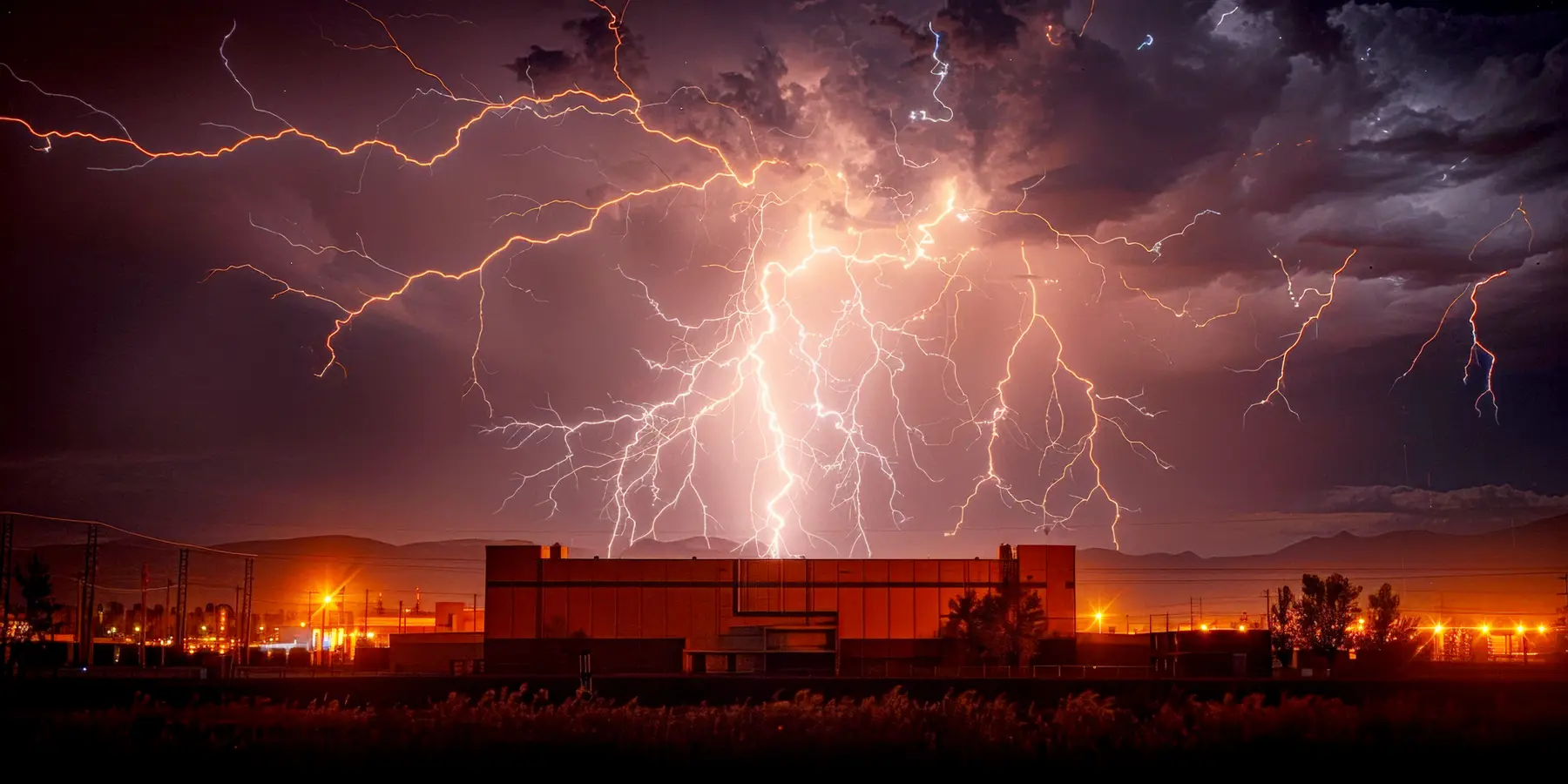
A lightning protection system (LPS) is the complete set of measures that intercepts a lightning strike, conducts it safely to earth, and protects the structure, the people inside it and its electrical systems.
It is not a single device but a coordinated whole: something to catch the strike, a clear path to carry the enormous current down to ground, an earth system to disperse it into the soil, and internal measures to stop that current causing damage on its way through.
The physical LPS is specified under Part 3 of IEC 62305, the international lightning protection standard. Crucially, an LPS is never one-size-fits-all. The standard works from risk: the type of structure, how exposed it is, what it contains and who relies on it all decide whether an LPS is needed at all and, if so, how demanding it must be. This guide explains the two halves of an LPS, the components that make it up, the four classes, and how a risk assessment turns those choices into a defensible design.
External and internal LPS
Every lightning protection system has two parts that work together, and it helps to keep them distinct because they defend against different things.
The external LPS catches the strike and gets rid of it. Its job is to give the lightning current a deliberate, low-impedance path so it does not find its own through the structure, its occupants or its wiring. It does this with three components in series: an air-termination system that intercepts the strike, down conductors that carry the current down the outside of the structure, and an earth-termination system that disperses it safely into the ground.
The internal LPS stops dangerous sparking inside. When a huge current flows down the external system, it raises the voltage of everything connected to it and can flash over to nearby metalwork or services, a real fire and shock hazard. The internal LPS prevents this in two ways: equipotential bonding, which ties the LPS, structural metalwork, pipes and incoming services together so they rise and fall in voltage together rather than sparking between each other, and a maintained separation distance, which keeps the LPS far enough from internal conductors that a spark cannot bridge the gap.
The components of an LPS
An LPS is built from a small number of well-defined parts. The first three form the external system that handles the strike; the rest protect the systems inside.
Air-termination system
What the strike actually hits: rods (finials), a mesh over the roof, or catenary wires above the structure, positioned so that lightning strikes them rather than the building. Placement is verified with methods such as the rolling sphere and protection angle. Read about air-termination methods.
Down conductors
The path that carries the captured current from the air termination down to earth. Several are spread around the structure so the current divides between them, which lowers the voltage on each and reduces the sparking hazard. Natural conductors such as steel reinforcement can serve this role.
Earth-termination system
The electrodes that disperse the current into the soil: a ring earth, rods or foundation earth. A low, stable earth resistance is what lets the current dissipate without raising ground potential dangerously. Read about earthing for lightning protection.
Equipotential bonding
Bonds the LPS to structural metalwork, pipework and incoming services, directly or through surge protective devices, so everything sits at the same potential during a strike and cannot spark across to internal parts. With the separation distance, it is the core of the internal LPS.
Surge protection (SPDs)
A strike radiates a lightning electromagnetic impulse (LEMP) that induces surges on internal wiring even without a direct hit. Coordinated surge protective devices (SPDs), with shielding and bonding, form the protection measures that keep those surges away from sensitive equipment.
Zoning (LPZ)
The interior is divided into lightning protection zones, from the exposed outside in to the most protected core, with SPDs and shielding at each boundary stepping the threat down. The zone concept is how surge protection is coordinated across a building. Read about LPZ zoning.
How lightning protection system components are specified
Knowing the six parts above is not the same as being able to specify them. IEC 62305-3:2024 (Ed.3) gives clause 5.5 to the components themselves, and the requirement there is stricter than most specifications assume. It names the parts one by one: conductors and air-termination rods, earth electrodes and their seals, the inspection houses over them, connection components, conductor fasteners, isolating spark gaps, earthing enhancing compounds, lightning strike event counters, and the components used in isolated systems. Every one of them has to take the electromagnetic forces a lightning current brings, and the stresses the design expects, undamaged. The standard says how that is proved: use components tested successfully against whichever part of the IEC 62561 series applies (5.5.1).
That single sentence is what separates a compliant LPS from an assembly of parts that merely look right. A conductor of the correct material and cross-section, joined by a clamp that was never tested to IEC 62561, is not a compliant system. The same clause pins the rest of the chain. Components are made from one of the materials Table 6 lists, which covers copper, hot galvanized steel, steel with electro-deposited copper, stainless steel, aluminium and lead. Another material is allowed where it matches those on mechanical strength, electrical performance and resistance to corrosion. A conductor fastener has to meet IEC 62561-4 (5.5.2). An insulating part, a stand-off or an insulated down conductor, has to meet IEC TS 62561-8 (5.5.4).
Connections carry a requirement that depends on the class, which is easy to miss when ordering. The number of connections along a conductor shall be kept to a minimum, and connection components are selected by their tested class under IEC 62561-1: class H for LPS class I and II, and class N for LPS class III and IV (5.5.3). So the class the risk assessment arrived at does not only set the geometry of the system, it reaches all the way down to which clamp is acceptable on the shelf.
LPS classes I to IV
Not every LPS is built to the same standard. IEC 62305 grades them into four classes, each tied to a lightning protection level, so the protection matches the threat.
Four classes, mapped to the LPL
An LPS is built to one of four classes, I to IV, and each maps directly to a lightning protection level (LPL). Class I corresponds to LPL I, class II to LPL II, and so on. The class sets the physical design parameters of the whole system.
Class I is the most stringent
A higher class means the system must capture a wider range of strike currents: a smaller rolling-sphere radius, closer air-termination and down-conductor spacing, and tighter bonding. Class I gives the highest interception efficiency; class IV the lowest.
The class is decided by risk, not preference
The required class falls out of the Part 2 risk assessment. A higher-risk structure needs a more efficient LPS to bring its risk below the tolerable level, so the assessment, not the designer's habit, determines whether class I or class III is enough.
The class drives every dimension
Once the class is fixed, it sets the mesh size, the maximum down-conductor spacing, the rolling-sphere radius used to position air terminations, and the bonding requirements. It is a consistent package rather than a set of separate choices.
How an LPS is specified, risk first
The single most important thing to understand about a lightning protection system is that you do not start by choosing one. You start by assessing the risk. Part 2 of IEC 62305 models the structure, its surroundings and the services connected to it, computes how often a strike is likely to cause real harm, and compares that against the level of risk that can be tolerated. Only if the computed risk is too high is an LPS specified at all.
The assessment does not just answer yes or no. It tells you which protection measures bring the risk back into line and how efficient they must be, which is exactly what sets the LPS class. A modest structure may need only a class III or IV system, or none; a data centre or petrochemical plant may need class I plus coordinated surge protection. This is why two similar-looking buildings can warrant very different systems. The risk, not the appearance, decides. For a worked, clause-by-clause walk-through, see how an IEC 62305 assessment works.
Design, inspection & maintenance
An LPS protects nothing on paper. Once designed to the right class, it has to be installed correctly and then stay in that condition for the life of the structure. Lightning protection is exposed to weather, corrosion and mechanical damage, and buildings change. A new rooftop plant, an extension or a severed conductor can quietly undermine a system that passed on commissioning.
For that reason IEC 62305-3 requires an LPS to be inspected and tested periodically, with the interval set by the class, the environment and the importance of the structure. Inspection checks the physical integrity of air terminations, down conductors and bonds; testing confirms the earth resistance is still within limits. An LPS is only valid while that inspection and testing remain current, which is why maintenance is part of the system, not an afterthought.
Conventional vs ESE air terminations
One point of confusion is worth settling. IEC 62305 specifies a conventional lightning protection system: passive air terminations (rods, mesh, catenary wires) positioned by the rolling-sphere, mesh and protection-angle methods. The protection it claims is backed by the standard's geometry and risk method.
Early streamer emission (ESE) air terminals are a separate approach, claiming a larger protected volume from a single mast. ESE is covered by national standards such as the French NF C 17-102, not by IEC 62305, and its enhanced range is contested. If a project is specified to IEC 62305, its LPS is the conventional system described above; ESE is a different method that should not be conflated with it. For the detail and where each applies, see ESE air terminals and IEC 62305.
Questions answered
What is a lightning protection system?
What are the main components of an LPS?
What are the classes of LPS (I to IV)?
Is a lightning protection system always required?
What is the difference between external and internal LPS?
How often must a lightning protection system be inspected?
Lumex computes the IEC 62305-2 method and shows the working. It does not certify a structure. You may not issue or submit a Lumex output until a competent person, qualified where the structure is located, has reviewed the inputs and the result and signed it.
The tolerable risk in IEC 62305-2 is not a fixed constant. Clause 7.3 NOTE 1 gives RT = 1×10⁻⁵ per year as a representative value of tolerable risk and adds that another value may be set once the case has been investigated in detail. Printed p.12 then lets national or local regulations fix RT, the tolerable frequency of damage FT, and the Annex A, B, C and E calculation rules and parameter values. Every Lumex assessment states the jurisdiction it was computed under and the values that applied.
Get started today