ESE lightning arresters (Early Streamer Emission air terminals) and their status under IEC 62305
Early Streamer Emission air terminals are sold as a way to protect a larger area with a single mast. This guide sets out, plainly and without taking sides, what an ESE terminal claims to do, where the method is standardised, why IEC 62305 specifies conventional air terminations instead, and what that means for a designer who has to comply with the international standard.
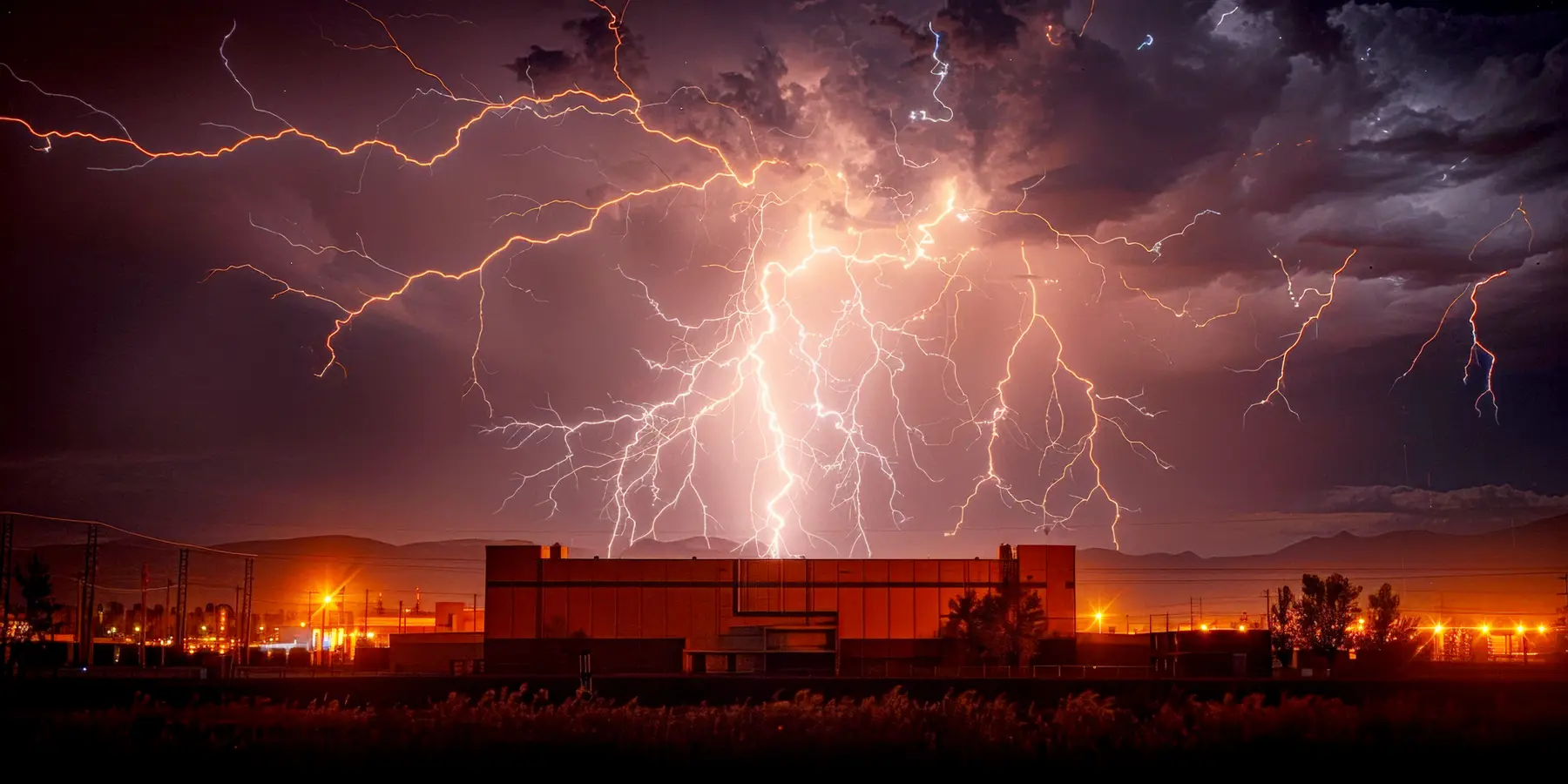
IEC 62305 does not include or endorse Early Streamer Emission (ESE) air terminals, also sold as ESE lightning arresters.
The international standard specifies conventional air-termination systems, rods, masts, catenary wires and meshed conductors, positioned by the rolling sphere, mesh and protection angle methods. ESE devices come from a separate national standard, NF C 17-102 in France, and similar national documents in other countries, not from IEC 62305. So if a project has to comply with IEC 62305, its lightning protection is designed with the conventional methods the standard sets out, and an ESE terminal sized by its enlarged-radius claim does not on its own show compliance with it.
That is the short answer, and it is worth stating cleanly because the question comes up on almost every project where a single tall mast looks cheaper than a full conventional array. The rest of this guide is the long answer. It sets out what an ESE terminal claims to do, where that method is standardised, what IEC 62305 specifies instead, why the international standard has not taken ESE in, and what all of this means in practice for a designer working to the standard. It names no manufacturer and takes no side beyond what the standards themselves say.
What an ESE air terminal claims to do
An Early Streamer Emission air terminal is a lightning rod with a device at its tip. A plain rod protects by being the most prominent metal point on a structure, so that as a downward leader approaches, the rod launches an upward connecting streamer and the strike attaches to the rod rather than to the building. The ESE proposal is that the tip device causes that upward streamer to start earlier than it would from a plain rod of the same height.
The argument runs from that earlier start to a larger protected area. If the streamer leaves sooner, the reasoning goes, it travels further before the strike attaches, and that head start is expressed as a time gain. The time gain is then converted, through the formula in the ESE national standard, into an enlarged radius of protection on the ground around the mast. In marketing terms this is what makes an ESE mast attractive: the promise is that one tall terminal covers an area that would otherwise need several conventional rods or a mesh.
Where the ESE method is standardised
The ESE method is not absent from all standards. It is standardised, just not in the international IEC series. The reference document is NF C 17-102, a French national standard published by AFNOR. It defines how an ESE terminal is to be evaluated, how the claimed time gain is established, and how that time gain and the mounting height are combined to calculate a protected radius. Several other countries have published their own national standards for ESE terminals built on the same general approach.
The key point for a designer is the boundary, not the detail. NF C 17-102 and its national equivalents are separate documents from separate bodies. They are not parts, annexes or appendices of IEC 62305, and IEC 62305 does not cross-reference them as an accepted alternative air-termination method. A design is built on one basis or the other, depending on what the project requires. Where a national code accepts an ESE design under its own standard, that is a decision of that jurisdiction; it does not make the device part of the international standard.
What IEC 62305-3 specifies instead
IEC 62305-3 specifies a conventional external lightning protection system, and positions its air terminations by three geometric methods. None of them grants an enlarged radius to a special tip; each is sized purely by the protection level the risk assessment arrived at.
Rolling sphere
An imaginary sphere of a fixed radius is rolled over and around the structure; anywhere it can touch is exposed and needs an air termination to keep the sphere off it. The radius shrinks for a higher protection level, so a more demanding system catches a wider range of strikes. It is the general method and works on any shape.
Mesh
A grid of conductors laid across a roof so a strike is caught by the nearest mesh wire and shared between the conductors around it. It suits flat and gently pitched roofs, and the grid is made finer for a higher class, so a more demanding system leaves less roof area between conductors.
Protection angle
A rod or mast protects a cone of space beneath it, bounded by an angle from the vertical. The angle narrows with height and with a higher protection class, which is why a tall mast protects a smaller footprint than its height alone suggests. It suits simple shapes and individual rooftop items.
The exact sphere radius, mesh dimension and angle for each protection level are set out in tables in the standard itself. The point to carry away is the contrast with ESE: in IEC 62305 a rod protects the geometric volume the rolling sphere or protection angle defines for its height and class, and adding a device to the tip does not extend that volume. A wider conventional layout uses more rods or a finer mesh, not a larger claimed radius per rod. For the full picture of the external system, the classes and the inspection that keeps it valid, see IEC 62305-3 and its inspection.
Why IEC 62305 has not adopted ESE
The reason the international standard specifies conventional terminations rather than ESE is not an oversight or a regional preference. It is that the central ESE claim, an enlarged protected radius from an earlier upward streamer, is contested, and the evidence put forward for it has not satisfied the international standard community that it can be relied on.
Two strands sit behind that position. The first is the physics of leader attachment. A lightning strike attaches through a process that is highly variable from strike to strike, and the laboratory conditions used to measure a streamer time gain do not straightforwardly scale to the voltages, distances and randomness of a real downward leader. A time advantage measured on a test bench does not transfer cleanly into a guaranteed extra radius on a building. The second strand is the field record. Independent scientific reviews, and the controlled and field studies published in the open literature, have not substantiated that an ESE terminal protects a meaningfully larger area than a conventional rod of the same height placed in the same position.
A standard can only write down a method whose results are agreed and reproducible. Because the enlarged-radius method has not reached that bar in independent assessment, the IEC working bodies have kept IEC 62305 on the conventional methods, whose geometry is well characterised and whose performance is not in dispute. This is a statement about the weight of evidence for a method, not a judgement of any product or maker.
What this means for a designer working to IEC 62305
If the project basis is IEC 62305, the path is settled: assess the risk, choose the protection level, and design a conventional air-termination system sized by the standard's own methods. ESE does not enter that route.
Start from the risk, not the hardware
Run the Part 2 risk assessment to decide whether protection is needed and to which lightning protection level. The protection level is an output of that work, and it sets how demanding the air termination has to be, before any product is chosen.
Position by the standard's methods
Lay out the air terminations with the rolling sphere, mesh or protection angle method for that level, combining them where the structure needs it. The protected volume comes from that geometry, not from a claimed per-rod radius.
Keep the basis on file
Record the protection level and the design so the periodic inspection can be judged against them. An inspector checks the as-built system against its design, so the air-termination method it was designed to has to travel with it.
Where a jurisdiction accepts an ESE design under a national standard such as NF C 17-102, that is a route on its own basis, with its own calculation and its own acceptance. What it is not is a shortcut to IEC 62305 compliance: a single ESE mast sized by an enlarged radius does not, by itself, demonstrate that a structure is protected to the conventional geometry IEC 62305 requires. When the specification, code or authority calls for IEC 62305, design to IEC 62305. For the wider context of where this standard fits among the others, see what IEC 62305 is.
The position in one paragraph
Early Streamer Emission air terminals are real devices, standardised under national documents such as NF C 17-102, and they claim a larger protected radius from an earlier upward streamer. IEC 62305 does not include or endorse that method. It protects structures with conventional air terminations positioned by the rolling sphere, mesh and protection angle methods, because the enlarged-radius claim has not been substantiated in independent scientific review or in controlled and field studies. For a project that must comply with IEC 62305, that settles the design: use the conventional methods, sized by the protection level the risk assessment arrived at.
Questions answered
Are ESE air terminals recognised by IEC 62305?
What is an Early Streamer Emission (ESE) air terminal?
Where is the ESE method standardised?
What does IEC 62305 specify instead of ESE?
What is the rolling sphere method?
Why has IEC 62305 not adopted ESE?
Can I use an ESE terminal on a project that must comply with IEC 62305?
Is NF C 17-102 part of IEC 62305?
What should a designer do who must comply with IEC 62305?
Lumex computes the IEC 62305-2 method and shows the working. It does not certify a structure. You may not issue or submit a Lumex output until a competent person, qualified where the structure is located, has reviewed the inputs and the result and signed it.
The tolerable risk in IEC 62305-2 is not a fixed constant. Clause 7.3 NOTE 1 gives RT = 1×10⁻⁵ per year as a representative value of tolerable risk and adds that another value may be set once the case has been investigated in detail. Printed p.12 then lets national or local regulations fix RT, the tolerable frequency of damage FT, and the Annex A, B, C and E calculation rules and parameter values. Every Lumex assessment states the jurisdiction it was computed under and the values that applied.
Get started today