Lightning protection levels (LPL I to IV) explained
A lightning protection level is the set of lightning current parameters a protection system is designed to handle. There are four, from the most demanding (LPL I) to the least (LPL IV). This guide explains what each level means, why you do not choose it on taste, how the risk assessment decides it, and how it sets the class of the protection system.
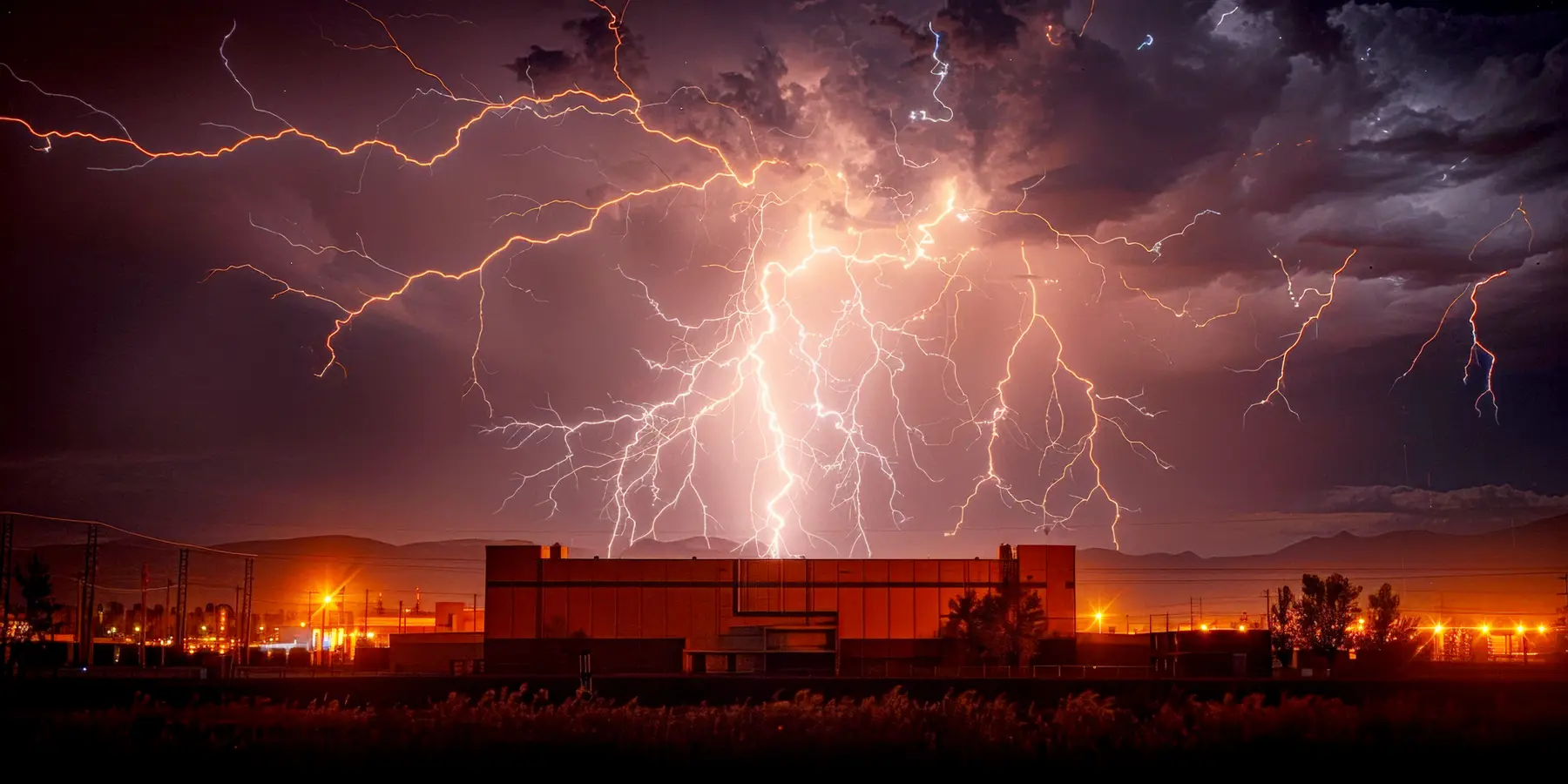
A lightning protection level (LPL) is the set of lightning current parameters a protection system is designed to handle.
IEC 62305 defines four of them. LPL I is the most demanding and is built to deal with the widest range of strikes, including the weak ones that are hardest to catch. LPL IV is the least demanding and is built for a narrower range. The higher the level, the more of the strikes that can occur it reliably intercepts, which is why a higher level is specified only where the consequences of a miss are most severe.
The key thing to understand is that you do not pick the level. The LPL is an output of the Part 2 risk assessment, not a setting you choose on judgement. You describe the structure, the method computes the risk, and the result tells you which level brings that risk below what is tolerable. That level then maps straight onto the class of physical protection system that gets installed. This guide explains what an LPL is, how the risk assessment decides it, how it maps to the LPS class, what becomes more demanding as the level rises, and why a higher level is not simply better.
What a lightning protection level actually is
Lightning is not a single, fixed event. Strikes vary enormously in how much current they carry and how fast that current rises. A protection system cannot be designed against every conceivable strike, so the standard groups the range of strikes into four bands and gives each band a level. A lightning protection level is, in plain terms, a statement of how severe and how wide a range of strikes the system is built to deal with.
LPL I covers the widest range. It is designed against the strongest strikes and, just as importantly, the weakest ones, which are the hardest to catch because they attach to a structure in ways a coarser system would miss. LPL IV covers a narrower range. The four levels are graded I, II, III and IV from most to least demanding, and each one fixes the lightning current parameters the protection has to handle. Those parameters are defined in Part 1 of the standard and underpin everything the later parts do. The exact current values for each level are given in the standard itself.
The LPL is an output of the risk assessment, not a choice
The most common misunderstanding about protection levels is that an engineer selects one. They do not. The level is decided by the IEC 62305-2 risk assessment, and it falls out of the calculation rather than going into it. You model the structure, its surroundings and the services connected to it. The method computes the risk the structure faces. Then it tests what level of protection brings that risk below the tolerable threshold. The level you end up with is the answer to that test.
This matters because it removes the level from the realm of opinion. Two engineers assessing the same structure to the same edition of the standard should arrive at the same level, because the level is computed, not argued. It also means the level is the lightest one that does the job. The assessment does not reach for LPL I to be safe; it finds the level that brings the risk into line and stops there. Picking a level by feel, ahead of the calculation, is exactly the prescriptive habit the risk-based standard was written to replace.
How LPL maps to the LPS class
The level decides how demanding the protection must be. The class is the physical system built to meet it. The mapping between the two is direct and one to one.
Once the risk assessment has arrived at a level, the protection system that gets installed is built to a matching class. The mapping is simple: LPL I needs a Class I lightning protection system, LPL II a Class II system, LPL III a Class III system and LPL IV a Class IV system. There is no translation step and no room for interpretation. The level and the class are two names for the same point on the same four-step scale, one used in the risk and design parameters, the other used for the installed hardware.
Class I
The most demanding. Specified where a miss carries the most severe consequences.
Class II
A step lighter, for structures whose risk is high but not at the top of the range.
Class III
For moderate risk, where a coarser system still brings the risk into line.
Class IV
The least demanding. Used where the assessment shows a lighter system is enough.
Because the class follows the level exactly, the level the risk assessment computes is what an installer builds to and what an inspector later checks against. The Part 3 inspection is judged against the class the structure was designed to, not a generic checklist, which is why the original level travels with the system for its whole life.
What gets more demanding as the level rises
Moving from LPL IV up to LPL I is not a single dial. Several design parameters tighten together, and they all push in the same direction: catch more strikes, more reliably, with less margin for a gap.
Smaller rolling sphere
Air terminations are positioned using an imaginary sphere rolled over the structure; wherever it touches needs protection. A more demanding level uses a smaller rolling sphere, which touches more surfaces and forces the system to catch weaker, closer strikes a larger sphere would roll straight past.
Finer mesh
Where a roof is protected by a grid of conductors, the grid is made finer as the level rises. A higher level leaves less roof area between conductors, so a strike has a shorter distance to the nearest protective wire.
Closer down-conductor spacing
Down conductors carry the current to earth, and they are spread more tightly around the structure at a higher level. Closer spacing splits the current between more parallel paths, lowering the voltage on each and the magnetic field inside.
Larger separation distance
The separation distance keeps unbonded metalwork far enough from the protection system that the strike potential cannot arc across. A more demanding level carries more current at a higher potential, so the required distance grows.
Higher interception efficiency
The share of strikes the system reliably catches rises with the level. LPL I captures the widest span of strike currents and the highest proportion of all strikes; LPL IV the narrowest. The exact figures are given in the standard.
Wider range of strike currents
Each level is defined against a band of strike currents it is built to handle. A higher level stretches that band, especially at the low end where the smallest, hardest-to-catch strikes sit, so it leaves fewer strikes outside what the system was designed for.
The exact sphere radius, mesh dimension, conductor spacing, separation distance and interception efficiency for each level are set out in tables in the standard itself. The principle to carry away is that they all move together: a more demanding level means a smaller sphere, a finer mesh, closer conductors, a larger separation distance and a higher proportion of strikes caught. To see how these parameters become real hardware, read the air termination methods that position the system on the structure.
The share of strikes a level catches
Interception efficiency is the idea that sits underneath the four levels. It is the proportion of lightning strikes a given protection level reliably catches. No level catches everything, because the smallest strikes, the ones carrying the least current, attach to structures in a way that a larger rolling sphere rolls past without ever touching the surface they hit. A smaller sphere touches more of those surfaces, so a more demanding level catches a wider span of strike currents, and therefore a higher share of all strikes.
This is why the levels are graded the way they are. LPL I has the highest interception efficiency, because it is built around the smallest sphere and the widest current band. LPL IV has the lowest, because it is built around a larger sphere and a narrower band. The exact efficiency figure for each level, and the current band each one spans, are given in the tables in the standard. The concept to hold on to is that the levels are a way of trading completeness of capture against the cost of a heavier system, with the risk assessment deciding where on that trade a particular structure should sit.
Why a higher level is not simply better
It is tempting to treat LPL I as the safe default, the level to reach for when in doubt. That instinct is wrong, and acting on it costs money or compliance. A higher level is not better in the abstract. It is only correct where the risk calls for it. The level is a match to a measured risk, not a quality rating where more is always preferable.
Over-specifying wastes money
Build a Class I system on a structure whose risk only warrants Class IV and you have paid for a smaller sphere, a finer mesh, more down conductors and larger separation distances than the risk justifies. The extra protection is real, but it buys down a risk that was already tolerable. That is money spent for no gain in safety the standard recognises.
Under-specifying fails compliance
Build a Class IV system where the risk demands Class I and the structure is left under-protected. The computed risk stays above the tolerable threshold, the assessment does not pass, and an auditor or insurer will reject it. Worse, the gap is invisible until a strike finds it.
The correct level is the one the risk assessment arrives at: neither heavier nor lighter. That is the whole point of computing it rather than choosing it. The assessment finds the lightest level that brings the risk below tolerable, which is by definition the right balance of protection against cost for that specific structure.
Where the level sits, from Part 1 to Part 3
The protection level is the bridge between the risk work and the hardware. It is defined in one part, computed in another, and built in a third.
Defines the levels
Part 1 sets out the four levels and the lightning current parameters each one is built against. It is where the vocabulary of LPL I to IV is established and where the values the other parts use are fixed.
Computes the level
The risk assessment models the structure, computes the risk, and arrives at the level needed to bring it below the tolerable threshold. This is where the level is decided, as an output. Read the method.
Builds the class
Part 3 takes the level as a Class I to IV system and turns it into air terminations, down conductors and earthing, then inspects it against that class for life. Read about inspection.
Read across the three parts, the level is chosen exactly once, by the assessment in Part 2, and everything before it defines the level while everything after it builds and maintains the system that meets it. For the wider picture of how the parts fit together, start from what IEC 62305 is.
Getting the level right, on every assessment
The level is only as sound as the assessment it comes out of. Model the structure carefully, to the current edition of the standard, and the level falls out correctly. Cut corners on the inputs, or run the numbers on an out-of-date method, and the level can come out wrong in either direction, leaving the structure over-built or under-protected without anyone noticing until it is challenged. The discipline is the same every time: describe the structure honestly, let the method compute the risk, and take the level it gives you.
Questions answered
What are lightning protection levels (LPL) I to IV?
Do you choose the LPL yourself?
How do you choose the LPL class?
How does LPL map to the LPS class?
What gets more demanding as the level rises from IV to I?
What is interception efficiency?
Is LPL I always better than LPL IV?
What is the relationship between LPL and the rolling sphere radius?
Why does the LPL not contain the actual current values here?
Where does the LPL sit in the IEC 62305 workflow?
Lumex computes the IEC 62305-2 method and shows the working. It does not certify a structure. You may not issue or submit a Lumex output until a competent person, qualified where the structure is located, has reviewed the inputs and the result and signed it.
The tolerable risk in IEC 62305-2 is not a fixed constant. Clause 7.3 NOTE 1 gives RT = 1×10⁻⁵ per year as a representative value of tolerable risk and adds that another value may be set once the case has been investigated in detail. Printed p.12 then lets national or local regulations fix RT, the tolerable frequency of damage FT, and the Annex A, B, C and E calculation rules and parameter values. Every Lumex assessment states the jurisdiction it was computed under and the values that applied.