Lightning protection zones and the separation distance
A lightning strike does its worst damage through the field and surges it spreads inside a building, not just at the point it lands. IEC 62305 answers that with two ideas: lightning protection zones that step the threat down from outside to the most sensitive equipment, and a separation distance that keeps unbonded metal far enough from the protection system to avoid a spark. This guide explains both, and how bonding and SPDs tie them together.
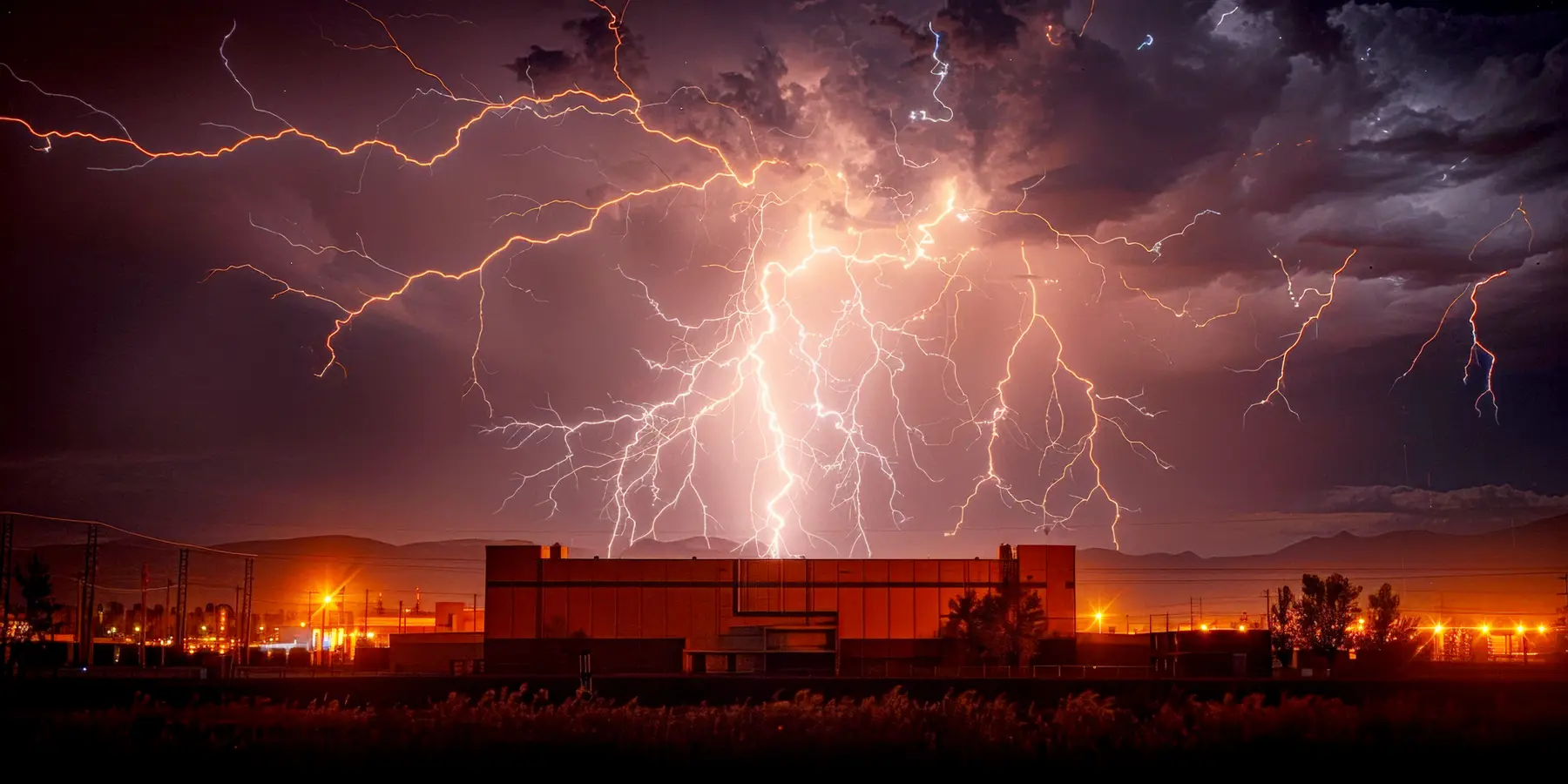
Lightning protection zones (LPZ) are regions of a structure graded by how severe the lightning threat is inside each one.
IEC 62305 divides a building into zones of decreasing threat, from the exposed outside where a direct strike and the full electromagnetic field are present, through to deep inner zones where the conducted surge and the field have been reduced enough for sensitive equipment to survive. A boundary between two zones is where the threat is stepped down, using the lightning protection system, spatial shielding, surge protective devices and the bonding of every conductive service that crosses it. The zone concept is how the standard protects the electronics inside against the lightning electromagnetic impulse.
Alongside the zones sits a second idea, the separation distance: the gap that keeps an unbonded metal part far enough from the lightning protection system that the high voltage on the system during a strike cannot jump across as a spark. Zones and bonding deal with the surge and field reaching the inside; the separation distance deals with dangerous sparking on the way down. This guide explains both, what defines a zone boundary, how surge protective devices and bonding sit on it, what drives the separation distance, and why this is the part of the standard that keeps electronics alive. New to the standard? Start with what is IEC 62305.
Why electronics fail even with a perfect external system
An external lightning protection system has a single job: intercept a direct strike and carry its current safely to earth. It does that well, and a structure with a sound system rarely suffers the fire or mechanical damage a direct hit would otherwise cause. Yet the electronics inside the same building can still be destroyed by the same strike, because the damage to internal systems does not come down the air terminals and conductors. It arrives by a different route.
A strike carries tens of thousands of amperes that rise to a peak in microseconds, and a current changing that fast radiates a strong, fast-changing electromagnetic field, which the standard calls the lightning electromagnetic impulse, or LEMP. That field passes straight through walls and induces a voltage in every conductor it crosses: power cables, data cables, and the loops that wiring forms from board to socket to device. The strike current in the protection system radiates the same field. So even when the external system leads the current cleanly to earth, the field it generates and the surge that field induces on the wiring reach the equipment regardless.
This is the gap the zone concept and bonding fill. A perfect external system handles the direct strike to the structure; it does nothing about the field that washes through the building or the conducted surge induced on the wiring. Protecting the electronics is a separate discipline built on dividing the building into zones, bonding everything that crosses a boundary, and clamping the surge at each step.
The zone concept, and how the threat is stepped down
IEC 62305 organises the problem by dividing a structure into lightning protection zones. Each zone is defined by how severe the lightning threat is within it, both the conducted surge that can reach it and the strength of the electromagnetic field. The zones run in order of decreasing threat, from the fully exposed outside to the most sheltered inner space, and the design goal is to make sure the equipment ends up in a zone quiet enough for it to survive.
The point of the structure is that it is deliberate. Rather than hoping the building happens to attenuate the surge and field enough, the designer decides which zone each piece of equipment needs to be in, then provides the boundaries that step the threat down to reach it. The idea covers the field and the conducted surge together: spatial shielding attenuates the field as you move inward, while surge protective devices and bonding deal with the conducted surge on the wiring at each boundary. A zone is only as good as the weakest of the two inside it.
LPZ 0A, LPZ 0B, LPZ 1 and beyond
The zones run from the fully exposed outside to the most sheltered inner space. Each step lowers the direct-strike risk, the conducted surge, or the electromagnetic field, and usually more than one at once.
Direct strike, full field
The fully exposed outside. A direct strike is possible here and the full, unattenuated electromagnetic field is present, so anything in this zone can be carrying the full lightning current. The roof above the air terminals and the open ground around the building are LPZ 0A.
Shielded from a direct strike
Still outside, but protected from a direct strike, for example under the cover an air-termination system provides. It is not subject to a direct hit, but it still sees the full electromagnetic field. The only difference from LPZ 0A is the direct-strike risk, not the field.
First protected zone inside
The first zone inside the structure. The conducted surge and the field have been reduced relative to outside, by the shield of the building, the bonding at the entry boundary, and the surge protective devices that clamp what enters on the wiring. Most of the interior of an ordinary building is LPZ 1.
Progressively quieter
Inner zones closer to sensitive equipment, each one a step lower in conducted surge and field than the last. A shielded enclosure, a screened room or a server hall inside an LPZ 1 building forms an LPZ 2, and a further enclosure within that can form an LPZ 3.
The two outer zones are both numbered 0 because neither is protected against the field; the letter separates the direct-strike risk. The inner zones rise in number as they get quieter. Equipment is placed in the zone whose threat it can withstand, and the boundaries are designed to deliver that zone, not the other way round.
What defines a zone boundary
A boundary is not a wall; it is the set of measures applied where one zone meets the next, all working to step the threat down at that line. Four things define it, and a boundary is only as strong as the weakest of them.
The lightning protection system. At the outer boundary, the external lightning protection system intercepts a direct strike and keeps the full current out of the zones behind it. This is what separates LPZ 0B from LPZ 0A: the protective cover of the air-termination system takes the direct-strike risk off everything beneath it.
Spatial shielding. The conductive parts of the structure, the reinforcing steel, metal facades and floors, and any screening added on purpose, attenuate the electromagnetic field crossing the boundary. A well-meshed reinforced structure shields far better than a frame with little continuous metal, which is why the field in LPZ 1 can be much weaker in one building than in another.
Surge protective devices at the boundary. Every live conductor that crosses the boundary, the power and data cables, carries a conducted surge with it. A surge protective device at the boundary clamps that surge down to a level the next zone can tolerate. The device at the LPZ 0 to LPZ 1 boundary, where the service enters, takes the largest surge; a device at the LPZ 1 to LPZ 2 boundary handles the smaller residual. How those devices are sized and coordinated is covered in SPD types 1, 2 and 3.
Bonding of every crossing service. Each conductive service that passes the boundary, including pipes, cable armour and structural metal, is bonded to a common reference at the boundary so it cannot carry a voltage difference into the protected zone. This is the part most often left incomplete. One untreated conductor, an unbonded pipe or a cable that bypasses the surge protective device, carries the surge straight past every other measure and undoes the boundary.
The rule that ties these together is simple to state and easy to break: at a boundary, everything that crosses it must be treated. A live conductor is treated with a surge protective device, a metal part with a direct bond. A single conductor left untreated is a hole in the boundary, and the surge will find it.
How surge protective devices sit at zone boundaries
Surge protective devices are the active element of the boundary, the part that handles the conducted surge on the live wiring, and they are placed precisely where the zones meet. A device at the entrance, on the LPZ 0 to LPZ 1 boundary, faces the largest surge, since that is where a cable crosses from the exposed outside into the first protected zone; a device deeper in, on the LPZ 1 to LPZ 2 boundary, handles only the residual that reached it. Each one reduces the surge to a level the next zone is built to accept, so the protection works as a chain from the entrance to the equipment. The first device also acts as part of the bonding at its boundary, tying the live conductors to the same reference as the bonded metalwork.
Because the devices depend on each other in sequence, what matters is not how many are fitted but whether they are coordinated. The type of device, the waveform it is rated against, and how the set is coordinated are explained in SPD types 1, 2 and 3 in IEC 62305, which picks up where the zone boundary leaves off.
The separation distance, and why an unbonded part can spark
The zone concept deals with the surge and field reaching the inside. The separation distance deals with a different hazard on the lightning protection system itself. When lightning current flows down the system, the system is raised to a very high voltage relative to nearby metalwork for the duration of the strike. If an unbonded conductive part, a pipe, a cable tray, a handrail, runs close to the down conductor, that voltage can flash over to it as a spark, which is dangerous in its own right and can ignite anything flammable nearby.
The separation distance is the minimum gap that keeps the unbonded part far enough away that the voltage cannot jump across. Hold the part at least that distance from the protection system and no flashover occurs. Where the distance cannot be achieved, because the part runs too close to the conductor to move, the answer is to bond the part to the protection system instead, so the two rise to the same voltage together and there is no difference left to drive a spark. Separation and bonding are the two ways of dealing with the same flashover risk: keep it far, or tie it in.
What drives the required distance. Four things set how much separation is needed. The first is the share of the lightning current expected to flow in that part of the system, since more current means more voltage. The second is the geometry, meaning the length along the conductor from the nearest bonding point up to the point in question, since the voltage builds along that length. The third is the number of down conductors, because more conductors split the current between them and lower the voltage on each. The fourth is the insulating material in the gap, since air withstands a lower voltage than solid insulation over the same distance. The standard expresses these through coefficients for the protection level, the current split and the material, and the exact values are given in the standard.
The practical lever is the number of down conductors. Adding them splits the current and shortens the effective run to a bonding point, both of which cut the separation distance required. That is why a building with many well-distributed down conductors is easier to protect than one with only a few: the same current spread thinner raises a lower voltage on each path.
Equipotential bonding, the other half of the answer
Equipotential bonding connects metal parts and incoming services to a common reference so they all sit at nearly the same voltage during a strike. Once everything is at the same potential, there is no difference to drive a spark between parts, and no difference to push a surge from one system to another. Bonding is the complement to the separation distance: where a part can be kept far enough away, separation handles it; where it cannot, bonding handles it. Every conductive part falls into one of those two treatments.
The same principle runs through the zone boundaries. At each boundary, bonding ties every crossing service to the same reference, so power, data, pipes and structural metal all enter the protected zone at one voltage rather than several. The live conductors cannot be connected directly, since they have to keep carrying their normal voltage, so the surge protective device is the bonding component for them: it connects them to the reference only during a surge, then isolates again. That is why the entrance surge protective device counts as part of the equipotential bonding at the boundary, not a separate measure beside it.
Where zones, separation and bonding sit in IEC 62305
The zone concept and the separation distance live in different parts of the standard, but they work as one scheme. Part 2 decides whether the protection is needed; Parts 3 and 4 set out how to build it.
IEC 62305-4, the zone concept
Part 4 covers protecting electrical and electronic systems from LEMP. It defines the lightning protection zones, the coordinated surge protective devices, the spatial shielding, the cable routing and the bonding as one protection measures system.
IEC 62305-3, the separation distance
The separation distance for the external lightning protection system is set out in Part 3, alongside the air terminations, down conductors and earth termination, with equipotential bonding of the structure. It is the rule that keeps an unbonded metal part far enough from the system to avoid a flashover.
The zone concept is what keeps electronics alive
The zone concept and bonding carry so much weight because a building can have a flawless external lightning protection system and still lose its electronics: the field and the conducted surge reach the inside whatever the air terminals do. The external system protects the structure from physical damage; the zones, the bonding and the surge protective devices protect the systems inside from LEMP. They are separate measures acting on separate kinds of damage, and a design with one and not the other is only half protected. This is why the standard treats internal protection as a system rather than a product: what protects the equipment is the whole chain, the zones defined deliberately, every boundary treated completely, every crossing service bonded or clamped, and the separation distance held wherever a part is not bonded. Miss one boundary or leave one conductor untreated and the surge takes that route.
How that internal protection is credited in the numbers, the way coordinated surge protective devices lower the probability of internal-system failure, is covered in the SPD guide and the risk method. For the external system the zones sit on top of, including the inspection that keeps it valid, see IEC 62305-3 inspection and testing.
From zones and bonding to a filed report
The zone concept, bonding and coordinated surge protective devices are among the measures that move an IEC 62305-2 result. Lumex runs the full Part 2 method on the building you describe, computes the internal-system failure components driven by LEMP, and shows how crediting the internal protection measures lowers the probability of failure and brings a failing risk into line, traceable clause by clause. To see the method end to end, read the IEC 62305-2 risk assessment, or explore the platform.
New to the standard? Start with what is IEC 62305, then read how surge protective devices sit on the zone boundaries this guide describes.
Questions answered
What are lightning protection zones (LPZ) in IEC 62305?
What is LEMP and why does it matter for internal systems?
What are LPZ 0A and LPZ 0B?
What are LPZ 1 and LPZ 2?
What defines a lightning protection zone boundary?
What is the separation distance in IEC 62305?
What determines the required separation distance?
What is equipotential bonding and how does it relate to the separation distance?
Where does the zone concept sit in the IEC 62305 standard?
Lumex computes the IEC 62305-2 method and shows the working. It does not certify a structure. You may not issue or submit a Lumex output until a competent person, qualified where the structure is located, has reviewed the inputs and the result and signed it.
The tolerable risk in IEC 62305-2 is not a fixed constant. Clause 7.3 NOTE 1 gives RT = 1×10⁻⁵ per year as a representative value of tolerable risk and adds that another value may be set once the case has been investigated in detail. Printed p.12 then lets national or local regulations fix RT, the tolerable frequency of damage FT, and the Annex A, B, C and E calculation rules and parameter values. Every Lumex assessment states the jurisdiction it was computed under and the values that applied.