Lightning risk assessment for hospitals
In a hospital the people most exposed to a lightning event are the ones who cannot move on their own, and the equipment most likely to fail is keeping someone alive. That puts the risk to human life at the centre of the assessment, with the failure of medical electronics close behind. This guide explains why hospitals carry exceptional weight under IEC 62305, which risks lead, and how a healthcare campus has to be modelled.
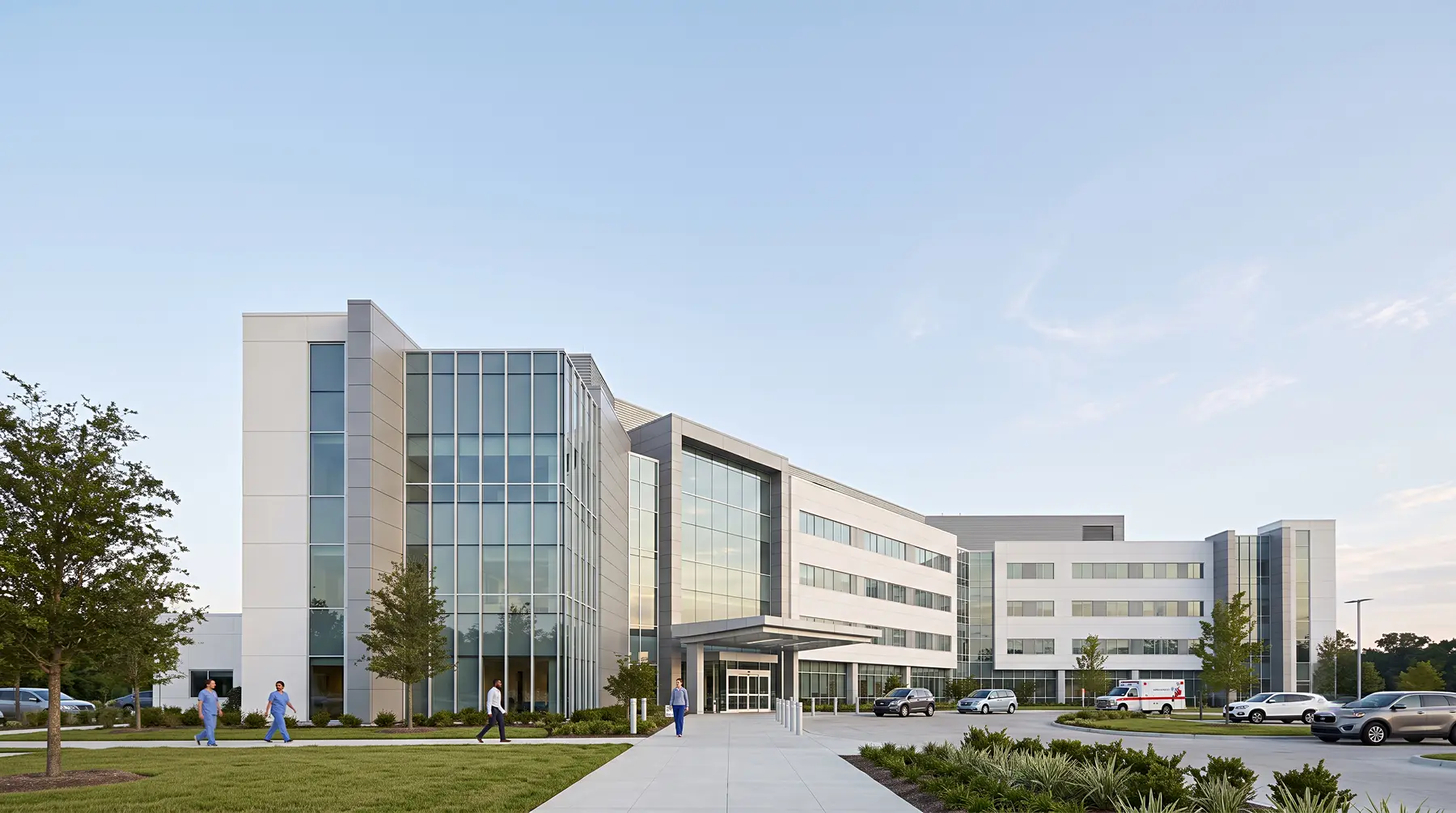
A hospital concentrates the three things lightning threatens most: people who cannot evacuate themselves, equipment keeping them alive, and a public service the surrounding area depends on.
A strike can injure people through dangerous voltages or fire, and a surge induced on an incoming line can disrupt the monitors, ventilators and imaging that a clinical area runs on, without any direct strike on the building. That is why an IEC 62305 risk assessment for a hospital puts the risk to human life first and treats the failure of medical electronics as a close second.
The standard and its method do not change for a hospital; what changes is the weight on each risk and the detail the model has to carry. The life-safety risk is exceptional because the people exposed cannot react or leave, the internal electronics are both sensitive and clinically critical, the building takes in an unusual number of services, and the site is rarely one simple box. This guide explains why life safety carries such weight, why loss of service also matters, why internal-system failure is central, how the many incoming services drive the result, what continuity expectations add, and what makes modelling a healthcare campus different in practice.
Why a hospital is an exceptional case
The same IEC 62305 method applies, but three things about a hospital move the assessment away from the ordinary-building case and put life safety, and the electronics that support it, at the centre of it.
The people cannot leave
Patients under anaesthetic, on ventilators or immobilised in intensive care cannot react to a hazard or evacuate. The assessment treats this presence of people at special risk and the difficulty of getting them out as central, which is what makes the life-safety risk so demanding.
The electronics are clinical
Monitors, ventilators, infusion pumps, imaging and the networks behind them fail at low surge levels, and the failure of one at the wrong moment is immediately dangerous. Protecting these internal systems is not a refinement here; it is part of keeping people safe.
A mixed-use campus
Wards, theatres, intensive care, diagnostics, plant rooms and often a helipad, sometimes spread across several buildings, with very different consequences in each zone. The risk is not uniform across the site, and the model has to follow that variation.
Life safety carries exceptional weight
IEC 62305 produces a risk of injury to people, R, and a separate frequency of damage, F, for the availability of the internal systems, and it recognises three kinds of loss, L1 to L3 (injury to human beings, physical damage to the structure and its contents, and failure of internal systems). The 2010 edition had a fourth, purely economic loss, which the 2024 edition removed. For most occupied buildings the risk R leads, because the worst outcome of a strike is harm to the people inside. A hospital takes that to its limit. The people inside are not only present in large numbers, they include patients who cannot move on their own and who depend on equipment that cannot safely stop.
So the risk of injury to people R leads a hospital study and carries weight an ordinary building does not place on it. The method accounts for the difficulty of evacuation and the presence of people at special risk, which tightens the margin the life-safety risk has to meet. A strike that injures people through touch and step voltages, or starts a fire in an occupied ward, is the outcome the assessment is built to drive down. This is close to the reverse of an unmanned data centre, where the availability of the internal systems leads and life safety is rarely the deciding risk, and it sets the whole tone of the hospital assessment.
New to how R and the frequency of damage F are built? The IEC 62305-2 risk method sets out how each is assembled from its components, and what is IEC 62305 covers the damage and loss model the risks rest on.
Why loss of service also matters
Life safety leads, but it is not the only risk a hospital has to answer for. A hospital is critical public infrastructure for the area it serves: emergency departments, surgery, diagnostics and inpatient care that the surrounding population relies on and that cannot simply pause. A lightning event that takes part of that capability offline, even briefly, affects far more people than the ones inside the building at the time.
That is the loss of service to the public that a hospital study has to weigh. An outage in power, in the clinical network, or in a system a ward depends on interrupts a service the public needs, and the frequency of damage F to those internal systems captures how often a strike would cause it. It rarely overtakes the life-safety risk as the deciding one, but it raises the consequence of an internal-system failure beyond the immediate clinical danger, and it is part of why a hospital is held to a higher standard of continuity than an ordinary occupied building.
Why internal-system failure runs through it
The standard groups what a strike can do into three types of damage: injury to people from touch and step voltages (D1), physical damage such as fire or explosion (D2), and the failure of electrical and electronic systems caused by the lightning electromagnetic pulse, or LEMP (D3). In a hospital all three carry real weight. The first two are the direct threats to life that the assessment always weighs, but the third, D3, the loss of internal systems, is unusually important because so much of the building's safety depends on electronics that fail easily.
LEMP is the mechanism. A strike radiates an electromagnetic field that induces surges on the wiring inside the building, and a surge arriving over an incoming line travels straight toward the equipment. Patient monitors, ventilators, infusion pumps, imaging and laboratory analysers fail at low surge levels, far below what a strike can induce. In a theatre or an intensive care unit the failure of one of these at the wrong moment is immediately dangerous, which is why the protection of internal systems sits alongside the protection of life, not below it.
This is where the assessment credits the protection measures. Coordinated surge protective devices on the incoming lines clamp the surge in stages before it reaches the equipment. A thorough equipotential bonding network ties the building steel, cable trays and metallic services together so dangerous voltage differences do not build up around patients and apparatus. Shielding of the most sensitive cable routes reduces how much of the field couples onto the wiring at all. And a lightning protection zone (LPZ) scheme divides the building into zones that step the surge environment down inward, so the intensive care units and theatres sit in the most protected zones. Part 4 of the standard sets out how these measures work together against LEMP, and the risk method gives the engineer credit for them by lowering the probability of internal-system damage.
For how the surge protective devices are graded and coordinated, see SPD types under IEC 62305, and for the zone scheme itself see lightning protection zones (LPZ).
A hospital takes in an unusual number of services
Few buildings are connected to as many conductive services as a hospital. Beyond its power feeds it takes in multiple data and telecom lines, nurse-call and fire alarm wiring, building management cabling, and in many cases metallic medical gas pipework running between a central plant and the wards and theatres. Every conductive service entering the building is a potential surge path, which is why the services, rather than the roof alone, are usually where the assessment finds much of the line-related risk.
Two properties of each line drive its contribution. The length sets how much of the surrounding ground a strike near it can couple into the cable, so a long external run collects more than a short one. The routing, whether the line runs overhead or buried, screened or unscreened, changes how much of a nearby strike actually reaches the building. Together these set the line-related risk components. The metallic services deserve particular attention: a medical gas pipe or a long signal run that is not properly bonded and protected at entry can carry a surge straight into a clinical area, so it has to be modelled as the conductive path it is.
This is the part of the IEC 62305 method that a single occupied building rarely stresses and that a hospital stresses hard. Getting the count, the lengths and the routing of the connected services right, the bonding of the metallic ones, and the SPDs that protect each entry, is much of what decides the answer for this kind of building.
In a hospital the tolerable risk is set by the people who cannot be moved.
The measures that move the result
For a hospital the protection that matters has to defend both the people and the electronics that keep them safe. The assessment decides which measures a building needs and where, so the spend lands on the zones and entries that carry the risk.
An external protection system sized to the risk
Air terminations, down conductors and an earth termination sized for the chosen protection level capture a direct strike and lead it to ground, away from the occupied areas below. This directly addresses the injury and fire damage that lead the life-safety risk.
Coordinated SPDs on every entry
Surge protective devices on the incoming power, data and signal lines, sized for the protection level and coordinated so each stage hands the surge down to the next. With so many services entering, this is usually the most effective set of measures for the internal-system risk, because the services are where the surge arrives.
Bonding that includes the metallic services
An equipotential bonding network tying the building steel, cable trays, medical gas pipework and incoming services together gives a surge a common reference and stops the voltage differences that endanger patients and equipment. Without solid bonding the SPDs have nothing dependable to clamp against.
Shielding, zoning and protection that fits
Screening sensitive routes and clinical rooms, and a zone scheme that steps the surge environment down toward the theatres and intensive care, reduce what reaches the equipment. The assessment decides which measures a building needs, so a critical zone is not left under-protected while a low-risk one is over-specified.
Continuity expectations on a healthcare building
Hospitals are built to keep running through a fault. Standby generation, dual power paths and protected distribution to clinical areas exist so that care does not stop when something fails. Lightning is one threat the standby and redundancy do not fully answer, because an induced surge can reach equipment on more than one power path at once and can disrupt the low-voltage signal and data systems the generators do nothing for.
An IEC 62305 assessment supports the continuity the building is designed for by putting a number on the lightning part of it. It estimates how often a strike-related event could injure someone or take a clinical system offline, and shows that the external protection, surge protection, bonding, shielding and zoning bring those frequencies below an acceptable level. It does not replace the standby power and protected distribution that clinical resilience is built on. What it gives is the recognised evidence that the lightning threat to both safety and continuity has been assessed on the numbers and controlled, rather than left as an assumption that the building is probably fine.
What makes modelling a hospital different
Four features of a real healthcare campus push the model away from the simple single-box case and have to be reflected for the answer to hold up.
A large mixed-use campus
A big site, often several connected buildings over a wide plot, has a large collection area and gathers more strikes near and on it over a year than a compact structure. The geometry feeds straight into how often a dangerous event is expected.
Zones with very different consequences
An intensive care unit, a theatre, a ward and a car park carry very different losses if a strike causes harm in them, so the assessment cannot treat the site as uniform. The people at special risk and the critical electronics concentrate the consequence in particular zones.
Helipad and rooftop plant
A rooftop helipad, chillers and other mechanical plant are exposed equipment in their own right, with their own cabling running back into the building, and the assessment has to account for that exposure rather than treating the roof as bare.
Many connected services
Power feeds plus multiple data, telecom, nurse-call, fire and building-management lines and metallic medical gas pipework mean the risk is spread across many entries, and each has to be modelled with its own length and routing rather than rolled into one figure.
A hospital, modelled to the clause
Lumex models a hospital as a structure with its zones, its many incoming services and its protection measures, then runs the IEC 62305-2 method across them. It shows how an external protection system, coordinated SPDs, bonding, shielding and the zone scheme bring the risk to life and the risk of internal-system loss below the tolerable level, and it lets an engineer set out the clinical zones, add each service with its own length and routing, and see the risk move as the protection changes. Every figure traces back to the clause behind it, so an authority, accreditation body or insurer can follow the reasoning rather than take a single number on trust.
New to the standard? Start with what is IEC 62305, then see the Lumex platform for how a building is assessed end to end.
Questions answered
Why do hospitals need an IEC 62305 risk assessment?
Which IEC 62305 risk matters most for a hospital?
Why does life safety carry exceptional weight in a hospital?
Can lightning damage hospital equipment without a direct strike?
What is D3 damage and why does it matter for a hospital?
How do incoming services affect a hospital's lightning risk?
What protection measures matter most for a hospital?
What makes modelling a hospital different from an ordinary building?
Does Lumex handle hospital lightning risk assessments?
Lumex computes the IEC 62305-2 method and shows the working. It does not certify a structure. You may not issue or submit a Lumex output until a competent person, qualified where the structure is located, has reviewed the inputs and the result and signed it.
The tolerable risk in IEC 62305-2 is not a fixed constant. Clause 7.3 NOTE 1 gives RT = 1×10⁻⁵ per year as a representative value of tolerable risk and adds that another value may be set once the case has been investigated in detail. Printed p.12 then lets national or local regulations fix RT, the tolerable frequency of damage FT, and the Annex A, B, C and E calculation rules and parameter values. Every Lumex assessment states the jurisdiction it was computed under and the values that applied.